by Leah Romero, Source New Mexico
February 18, 2026
With less than two years until the deadline for New Mexico victims of nuclear radiation to apply for Radiation Exposure Compensation Act funds, U.S. Sen. Ben Ray Luján (D-N.M.) and advocates on Tuesday encouraged people to take advantage of available resources.
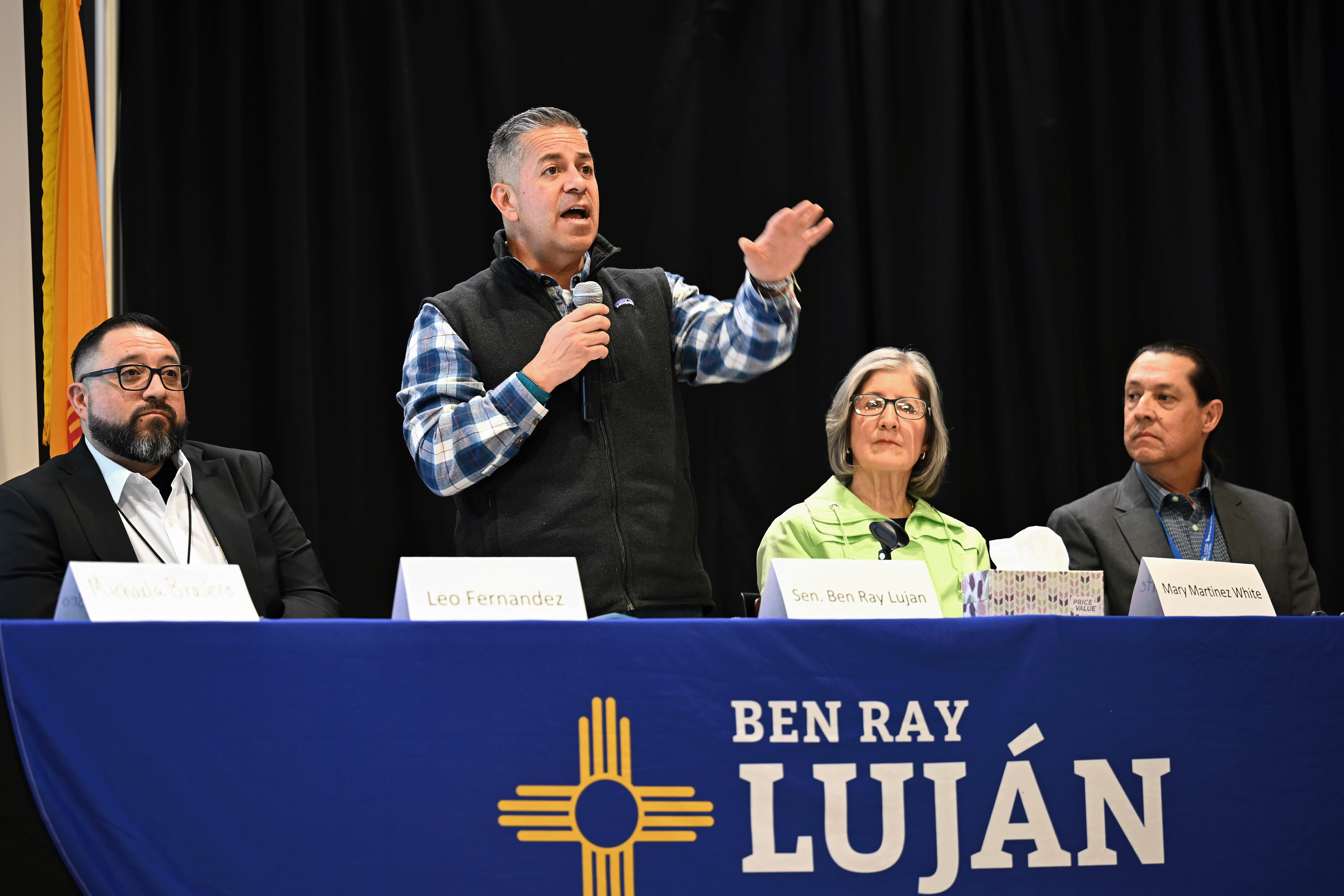
During a a RECA forum in Las Cruces, medical experts joined Luján, along with members of the Tularosa Basin Downwinders Consortium, to discuss the compensation that recently became available to New Mexicans impacted by the 1945 Trinity Test, along with the state’s post-1971 uranium miners.
The U.S. Congress passed a two-year extension to the act in July 2025 and expanded it to compensate eligible New Mexicans who developed one of the 19 qualifying cancers due to radiation exposure with one-time payments of $100,000.
According to the U.S. Department of Justice’s website, 676 downwinder applications from across the country had been submitted as of Feb. 18, 2026, with an additional 3,463 applications pending. The approval rate is 100%.
“This was a piece of legislation that recognized that because of the federal government, because of testing, because of work that people were sacrificing working in uranium mines, because there was no safety apparatus around them, because there was no warning, people got sick,” Luján said during the forum. “This legislation will never make someone fully whole again, but this legislation will help to pay some of those health care costs and recognize the damage that was done by the United States with causing this exposure.”
The deadline for applying for compensation is Dec. 31, 2027, at which time the program will sunset. Applications can be submitted by mail or online, and the consortium, along with the offices of New Mexico’s congressional delegation, is training volunteers to help people navigate the process.
Liz Marrufo, a retired educator and consortium volunteer, said she was not familiar with RECA until she crossed paths with the consortium. And after looking into it, she said she realized she and her father qualified for compensation.
Marrufo said it took some time to gather the required documentation, but it only took 38 days from submitting her application before it was accepted and she received the funds. Now, she and a group of volunteers are helping others fill out applications for free.
“We’re in Las Cruces, we’re local and we’re willing to help anyone. We accept no fee. We just tell people, pay it forward, contact people you know who may have been affected by one of the cancers,” Marrufo said. “The application is very simple. Don’t let it intimidate you…We want you to be able to keep every cent that you are entitled to.”
Audience member Jo Galván Nash said she had uterine cancer when she was about 50, but the list of eligible cancers does not include this particular type. “Why isn’t it eligible and are we working to enlarge the number of cancers that you can apply,” she questioned during the meeting.
Mary Martinez White said she and other consortium volunteers are already looking ahead and advocating for more radiogenic cancers to be added to the qualifying list, as well as a wider timeframe for exposure than the act currently states.
“There are 40 radiogenic cancers. Nineteen have been covered in this legislation. We’re happy that that is the case, that we have gotten these 19 covered, but again, our work is not done,” Martinez White said. “We hope that the senator and many others will stay with us as we continue to try to get more people covered under this legislation.”
Source New Mexico is part of States Newsroom, a nonprofit news network supported by grants and a coalition of donors as a 501c(3) public charity. Source New Mexico maintains editorial independence. Contact Editor Julia Goldberg for questions: info@sourcenm.com.