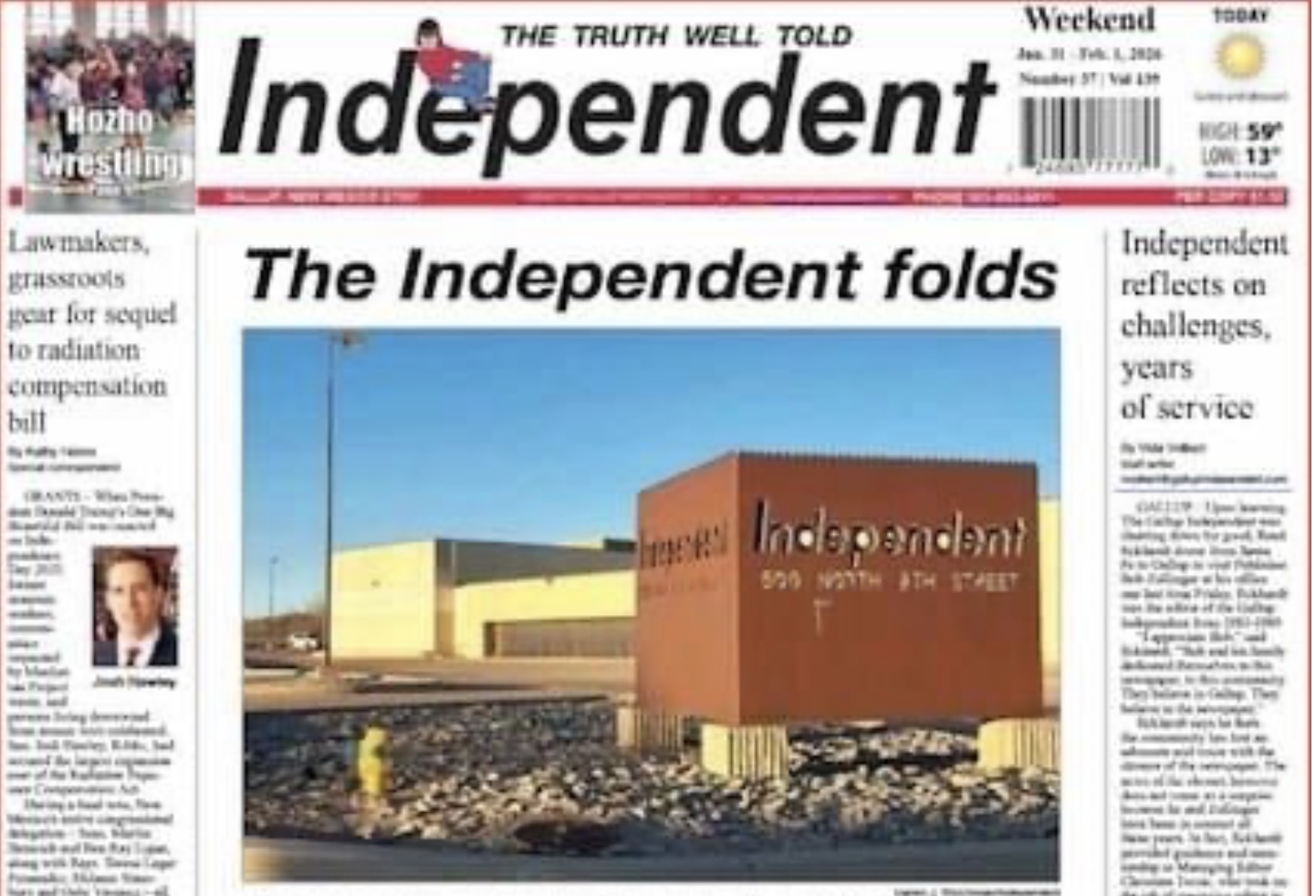
Just weeks after the New Mexico Legislature approved a package of tax credits aimed at supporting local journalism. Gallup is already adjusting to life without one of its most familiar institutions.
The Gallup Independent printed its final edition Jan. 31, after 62 years of daily coverage in the city, leaving residents a hole in news coverage.
“There was immediate disbelief and sadness in the community” said Richard Reyes a former managing editor of the paper and current board chair of KGLP-FM, a public radio station in Gallup. “People grew up with the Independent. It was their first job, their first connection to journalism.”
For years the paper documented the rhythms of Gallup city council decisions, school board meetings, local elections and high school sports.
Those stories often routinely formed a steady record of public life. Without them, the flow of local information has become less certain, and the spaces where those stories once appeared are now noticeably empty.
“People are just concerned that their community will not get the coverage that it needs,” Reyes said. “We don’t have that community watchdog anymore.”
Gallup’s situation reflects a broader shift across New Mexico and the country, where local news outlets have steadily disappeared or scaled back operations. In many smaller communities a single publication often carries the bulk of local reporting. When it closes there are few alternatives ready to take its place, and rebuilding that coverage is far more difficult than maintaining it.
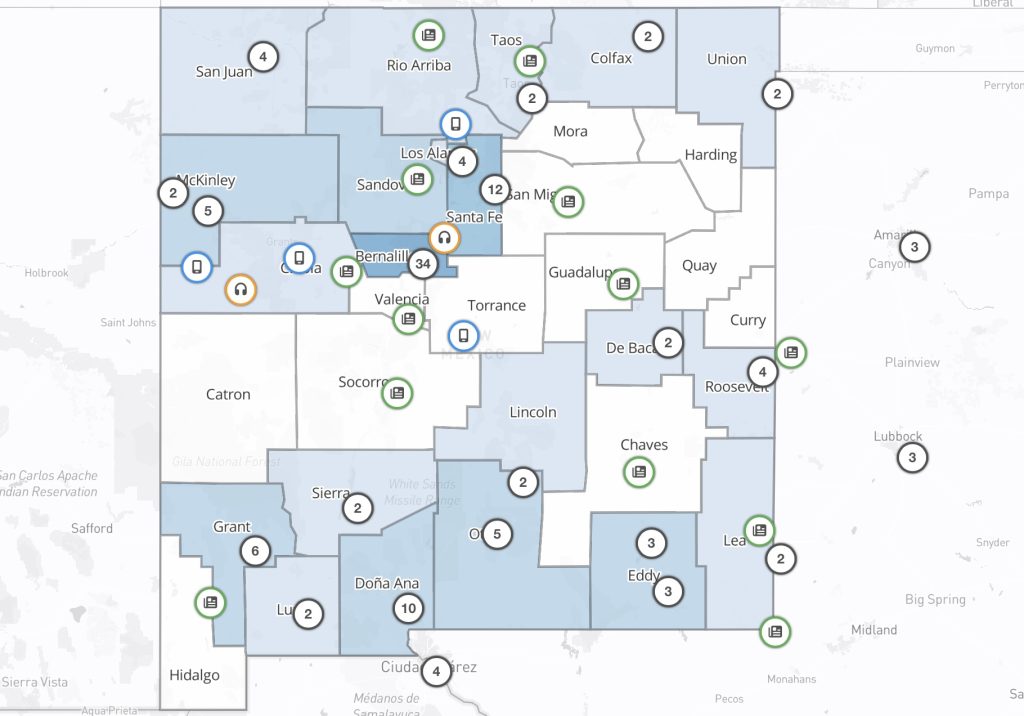
Data from the New Mexico Local News Ecosystem Report, conducted by current and former UNM researchers, shows large portions of the state at risk of becoming “news deserts,” particularly in rural areas where maintaining a newsroom has become increasingly difficult.
These communities can lose not just coverage but continuity fewer updates fewer records and fewer stories that reflect daily life. Over time that absence can reshape how informed a community feels about itself.
For those working in journalism across the state the trend has been years in the making. Mike Marcotte, an author of the report and a media leader involved in statewide journalism initiatives, said the pressures facing local outlets have fundamentally reshaped the industry.

“The business model that supported local journalism for decades has fundamentally changed” Marcotte said. “Advertising revenue has shifted, audiences have moved online and smaller markets are often the hardest hit.”
The effects are not always immediate but they build quietly. Without consistent reporting, fewer people are present in rooms where decisions are made and fewer questions are asked on behalf of the public.
“When a newspaper closes the first thing you lose is consistent coverage” Marcotte said. “That means fewer people are watching what local governments are doing fewer stories are being told about the community and fewer voices are being heard.”
In Gallup that shift is already beginning to take shape. The absence of regular reporting means fewer routine updates on public meetings and local decisions-information that rarely reaches broader outlets but shapes everyday life. Without those updates, staying informed requires more effort and in some cases information may not reach the public at all.
Reyes described it in familiar terms.
“You talk about food deserts, places that don’t have grocery stores” he said. “Now you have something called a news desert where there is just no news.”
The tax credits passed by the legislature are part of a growing effort to slow or reverse that trend. Designed to support local newsrooms and encourage hiring the incentives are intended to keep journalists working in communities that might otherwise lose them. Supporters say the goal is to create stability in an industry that has faced years of uncertainty.
Whether that support can make a lasting difference remains an open question particularly in smaller markets where financial challenges are more pronounced.
“Tax credits can help stabilize things in the short term” Marcotte said. “But they’re not a complete solution. The industry still has to adapt to new ways of reaching audiences and generating revenue.”
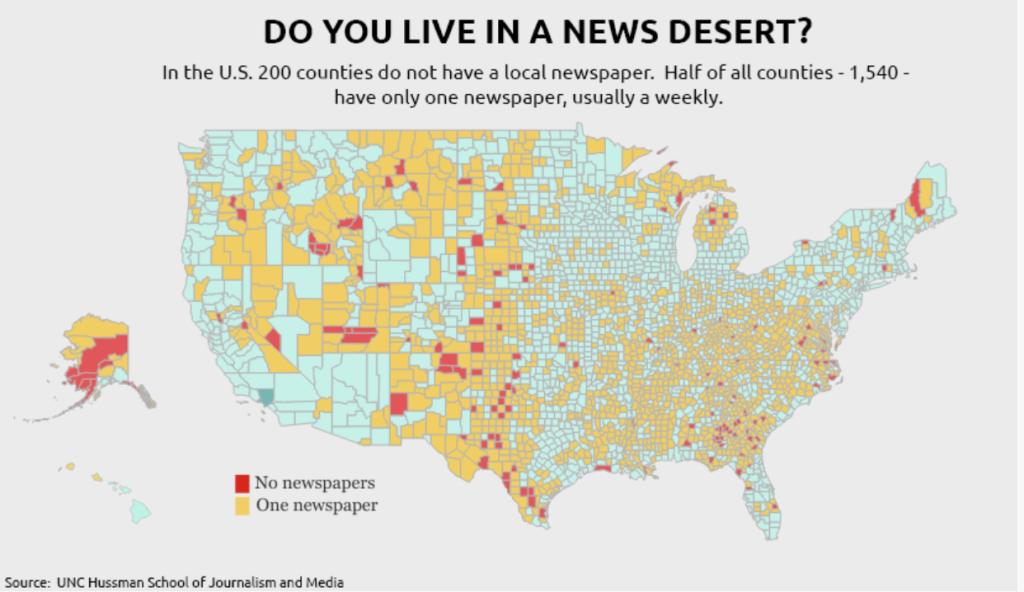
A national map from the UNC Hussman School of Journalism and Media illustrates counties across the United States with limited or no local newspapers, emphasizing the widespread reach of news deserts.
The shift toward digital platforms has changed not only how news is distributed, but how it is funded. Advertising models that once supported print publications have weakened, and newer models have not always provided the same level of sustainability for local outlets.
In some places timing has already become part of the story.
“In some cases like Gallup the help simply didn’t arrive soon enough” Marcotte said.
With the newspaper gone attention in Gallup has begun to shift toward what remains—and what might replace it. The loss has created both a gap and an opportunity, as other organizations consider how they might expand their role in covering local issues.
At KGLP conversations have turned toward increasing local coverage. The station’s long part of the community is now considering how it can take on a larger role in reporting on the issues that affect residents.
“I don’t think we’ve served our listeners the best when it came to local news” said Raymond Calderon, a business owner and KGLP board member. “But now… we are really looking to fill that void.”
The approach may not mirror a traditional newspaper but even small steps, short updates, summaries of meetings, or regular check-ins on local issues could help restore some level of consistent coverage.
“There is an opportunity there for a station like KGLP to bring some local news” Calderon said.
Other possibilities are emerging as well. At the University of New Mexico’s Gallup campus, student journalists are seen as part of a potential path forward, bringing new approaches and formats to local reporting. As media habits continue to shift younger journalists may play a role in reshaping how local stories are told and shared.
“There’s an energy in student journalists,” Reyes said. “They’re excited to tell these stories and learn about their community.”
For Calderon public radio can provide a place for those voices to be heard offering access to an audience and a platform for storytelling that might otherwise be difficult to find.
“We are there to be the microphone for students,” he said.
Even as those efforts take shape the loss of the Gallup Independent underscores the broader challenges facing local journalism. Financial pressures, shifting audiences, and changing technology continue to reshape how news is produced and consumed often faster than communities can adapt.
Efforts at the state level may help slow that decline but they are only one piece of a much larger transition. Sustaining local journalism will likely require a combination of approaches from policy support to new business models and community engagement.
“It’s going to take a combination of policy, innovation, and community support,” Marcotte said. “There’s no single fix.”
In Gallup that transition is no longer theoretical. The paper that once documented daily life is gone and what replaces it remains uncertain. The structures that supported local reporting are changing and the path forward is still being defined.
For now the stories are still there. City meetings, school decisions, community events but the question of who will tell them and how they will reach the public is still unfolding.