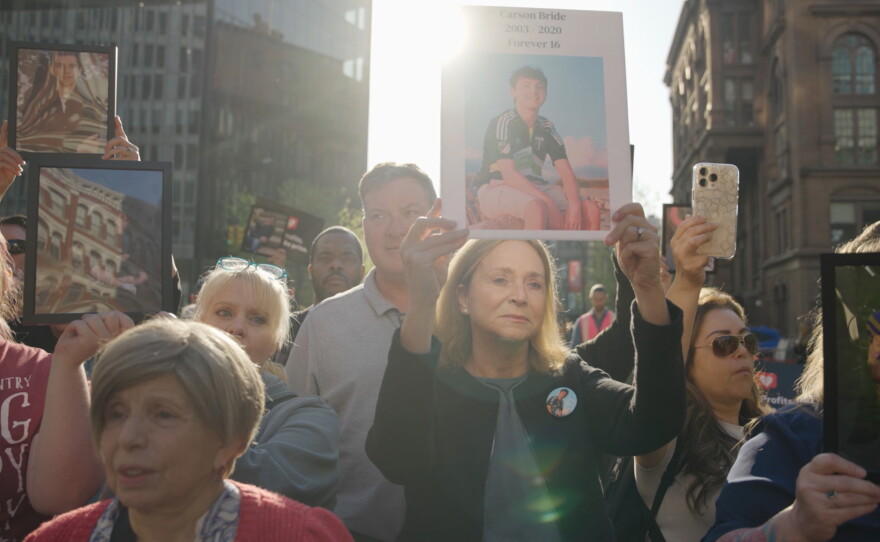
The National Hispanic Cultural Center in Albuquerque will screen a new documentary called “Your Attention Please,” on Friday October 2, 2026 which examines the human cost of the unregulated technology employed by social media platform Meta. The event is hosted by State Senator Antonio Maestas and Attorney General Raúl Torrez. Torrez successfully sued Meta and is up for re-election this year. KUNM spoke with film’s director Sara Robin and writer and editor Jack LeMay about New Mexico’s leading role in suing Meta.
JACK LEMAY: In August this year, a judge ruled in New Mexico saying Meta is a public nuisance, it has caused this public harm, and there are certain design changes that have been demanded of the platform, screen time limits for youth not over 90 hours per month, not pushing adult account content to them.
SARA ROBIN: You know a lot of people felt like they’re untouchable. There’s nothing you can do, and I think New Mexico has really shown that is no longer true, and we’re now able to actually have a conversation about how should these products be designed so that they’re healthy, so that they bring out the best in us, and not make us more divided, more angry, and cause a youth mental health crisis.
KUNM: Can you talk a little bit more about section two thirty liability?
ROBIN: Section 230, it was created to help free expression on the internet. So I think it was a very idealistic law and a very positive law at the time, what it says essentially is you as a publisher, as a website, as a platform, you’re not responsible for third-party content that’s being published on your site. That in itself makes a lot of sense, right? Like you don’t want to be taken to court just because someone said something on your platform. Now, what has changed though in the last 30 years is these platforms are no longer just passive platforms, they have highly sophisticated recommender algorithms that feed us content, and because they are proactively feeding us content, the argument now is that section 230 protection should no longer indiscriminately apply. We actually need to look at where does responsibility lie? And some examples that we’re showing in the film is that unfortunately children get sent content that is dangerous, and that is one of the things that we’re looking to change.
LEMAY: It’s basically like our internet laws are in the Stone Ages, and now we’re living in like the crazy sci-fi future. So we gotta bring those laws way up into the modern moment with us. Even our film tries to call attention to the history of how we went from an internet of free expression to an internet dominated by a few tech platforms that kind of control what we see, how we feel, how we communicate with each other, and now we’re seeing all of that sort spawn in this new frontier of AI, where the stakes are higher, as far as the business model, the incentives, what we want-you know-we want people basically hooked on these things. But the research is pretty clear that that is not the best layout for us to be using these tools. The tools should not be trying to replace the relationships that we have in the real world. They should be helping us to solve problems and get us back into the real world.
KUNM: What are some of the challenges teens and parents face?
ROBIN: There’s unfortunately a plethora of content out there that currently these recommender algorithms will actively send to kids, even when kids aren’t seeking it out. So we’re seeing examples of you know a child might be like, “Give me some inspirational content because I’m feeling down, and then a fraction of that is actually going to be pro-suicide content because the algorithm has figured out when someone’s feeling down, they look at that, and just to be clear, it’s not like there’s some evil algorithm trying to harm our kids. It’s just–it’s math. It just has learned algorithmically that you know kids are feeling down. We’ll look at this content, and so it sends them more of that content, and that is some of the extreme cases of how this is going wrong right now, and I think something that every parent should be aware of.
KUNM: Are there any solutions to combat these AI sites?
LEMAY: It’s not all doom and gloom. One thing that we really wanted to do in our documentary is make something empowering. So we have Trisha Prabhu, who has a company called ReThink, and she has basically designed anti cyberbullying technology that would be really easy to introduce into social media platforms, where you basically just give kids a gentle nudge when they’re writing really toxic, mean things to each other, like “Hey, there’s a real person on the other side of the screen”, and it turns out something that small of making a kid go like, “Oh, yeah, I kind of forgot that. Maybe I won’t say this mean thing” is really effective. About 93% of kids change their mind.
KUNM: What do you want viewers to take away from this film?
ROBIN: So what we always say is we’re not anti tech, and this is definitely not you know a doomsday film. What we’re asking for is better tech and more balance between being plugged in and being able to unplug, so that we can be present with each other and enjoy the moment and not be constantly elsewhere, right? That change is possible. I would say change is possible, and change, in fact, is already happening. You know, there’s so many inspiring individuals out there creating a different technology future, a healthier one, a more exciting one. So I think it’s really up to us, the people, to make our voices heard.
“Your Attention Please” will have a local screening Friday October 2, 2026 at 5:30pm at the National Hispanic Cultural Center in Albuquerque. Seating is limited and reservations are required here.
The film will be available on the streaming services Apple TV on Tuesday October 6th. Watch the trailer here.