SILVER CITY — The Grant County Commission approved an ordinance Thursday banning the development of data centers and their supporting infrastructure within Grant County for one year.
The version adopted was chosen over a modified version that would have more clearly allowed for prospective developer Granite Renewables to pursue a solar generation project on property at the southern end of the county and complete a feasibility study for colocation of a data center. The vote was 4-1, with District 5 Commissioner Thomas Shelley in opposition.
“The public has been reaching out — they are looking for more information, and they want information before some of this proceeds,” said Commission Chair Chris Ponce. “I hope that this commission does what it says it’s going to do: get information for the public.”
Members of the public have indeed turned out in numbers to make public comments at the beginning of this and several prior commission meetings — with a majority speaking in favor of the moratorium.
“We know that these data centers will make long-term claims on our resources,” said resident Paul Walmsley, who said he is an engineering manager for a company involved in the AI industry. “To assess the value of … these data centers to Grant County, we must consider whether these long-term claims, lasting over decades, will provide sufficient benefits to Grant County citizens. I don’t believe we know that yet.”
Several commenters responded to the Oct. 8 Zoom presentation to the commission by project developer Blake Marcus. Gila Resources Information Project Director Allyson Siwik returned to the podium for the third time on this topic, saying she still had more questions than answers.
“I’m still unclear about this project being a data center operating off of 5,000 acres of solar with battery storage, or powered by the 300 megawatts of natural gas that could emit over 1 million tons a year of carbon emissions and other air pollutants — or maybe it’s both,” Siwik said. “The Granite Renewables presentation gave us a flavor of the scale of these hyperscale data center projects, and the range of potential impacts to our community.”
Another commenter, 10-year-old Lofton, pleaded on behalf of children like him with compromised respiratory health.
“I, for one, do not want future kids to have to worry about bad lungs,” he said. “My parents said anyone could come and talk to you, so I wrote down my concerns about the data centers, and here I am.”
Lawrence Hurt — the owner of the property where the Site Layer 1 project is proposed — spoke up to oppose the moratorium, admitting that he stood to benefit if it failed.
“The primary beneficiary of this project would be Grant County and the citizens of Grant County. The tax benefits could be significant,” Hurt said. “I’m familiar with two solar-powered generation projects in Luna County. … The tax revenue from those two projects to the county in Luna County is going to be right around $30 million over the life of the project.”
Adrienne Bell, representing Site Layer 1 from law firm Holland and Hart, said the moratorium would create undue hardship for the project.
“Financing, interconnection and permitting timelines depend on regulatory predictability, and a project cannot simply be paused and restarted a year later,” Bell said. “A defined timeline and scope for regulatory work would serve the county better than an open-ended moratorium. And other tools like a community benefits agreement would give the county input on specific issues to the project and location.”
Several commenters remained until the official hearing on the ordinance and gave sworn testimony there, including recent resident and amateur astronomer Kevin Hearst.
“I run the telescope at the City of Rocks, doing the astronomy program,” he said. “I share the night sky with the public. I love to do that. And one of the things in this data center is, when you look at this, what is their light pollution output going to be?”
“If I may take a step back in history, we as Native people were placed on reservations,” said CDT Trail Coalition regional representative Cornell Torivio. “Our lands were taken from us. This was known as Western advancement, colonization, assimilation. Those same threats that came into our lands is now coming into your homes.”
Marcus himself appeared in person Thursday and spoke during both public comment and the hearing.
“We would like to be collaborative in the process of developing regulations and engaging with the community to develop impact and benefits agreements,” he said. “And the work on all of these aspects can begin immediately without the need for a moratorium.”
Marcus said that preliminary feasibility studies from regional energy provider Tristate should be received around next February, and will inform the scope and scale of the data center development. He said Granite Renewables intends to pursue the 715 megawatt solar-and-battery storage project regardless of the data center feasibility. The solar project would be “in front of the meter” and generate energy available to anyone on the grid, not just the data center, but could arguably be threatened by the language of the moratorium.
“We respectfully ask that the board not approve a moratorium, or exempt projects like ours who have put significant development efforts based on the current regulations,” Marcus said. “Alternatively, if the board does move forward, we ask that the ambiguity in the draft ordinance be removed so that a moratorium does not apply to any front-of-the-meter generation.”
Several commenters had expressed worry that if energy generation were allowed to move forward, the data center would become inevitable.
Ponce said he was offended by the implication that the moratorium would preclude dialogue. He read from a letter from Site Layer 1 to the commission saying the moratorium would “[prevent] the board from conducting its own analysis and entering into dialogue with Site Layer 1.”
“The newspaper and our citizens are the ones that brought this to our commission’s attention,” Ponce said. “We started to enter into this dialogue a little late, but I think the dialogue’s starting to go. … I think the dialogue needs to be there, and I think the information needs to come in a little better than what it was.”
It was for this reason, Ponce said, that he had moved to adopt the original of two versions of the ordinance.
District 4 Commissioner Eddie Flores echoed Ponce’s concern about a lack of effort on the part of Site Layer 1.
“Maybe they thought that they could just slide it under the radar, because that’s what they did in an … ad in the back page of the Press,” said Flores.
He was also concerned with the quality of Site Layer 1’s presentation over Zoom at the previous meeting, which was plagued by low-quality audio and whose message he had struggled to hear.
“The only reason Site Layer 1 is here today is because we’ve raised such a huge concern, which is a shame,” Flores said. “All it would cost them was an airline ticket like it did today to get down here, and they could have been discussing this.”
District 3 Commissioner Nancy Stephens said a year’s moratorium is not that long.
“There’s nothing wrong with having a legal pause instead of just a handshake,” she said. “I am not against all data centers. There may be a way where it could be done right.”
Shelley said that many speakers had mischaracterized the revised moratorium that he and Stephens had worked on to try to address the ambiguities raised by Marcus about activities prohibited during the moratorium.
“Some attorneys or groups may interpret the word ‘develop’ as meaning, well, you can’t do the environmental studies that you would normally do to meet the state and federal laws,” Shelley said. “They’re gathering information that would actually answer some of the questions that are being raised by the community. So, does this language in this original proposal say, ‘Hey, you have to stop on that. We don’t want to see your information?’ It could be interpreted that way.”
Shelley said his biggest personal concern was the potential impact of the energy generation on ratepayers. Site Layer 1 said they intended to commence the evaluation process on Oct. 28 to determine how much energy they would be able to use. Neither Marcus nor Bell said explicitly whether Site Layer 1 would pull back on this process as a result of the ordinance language.
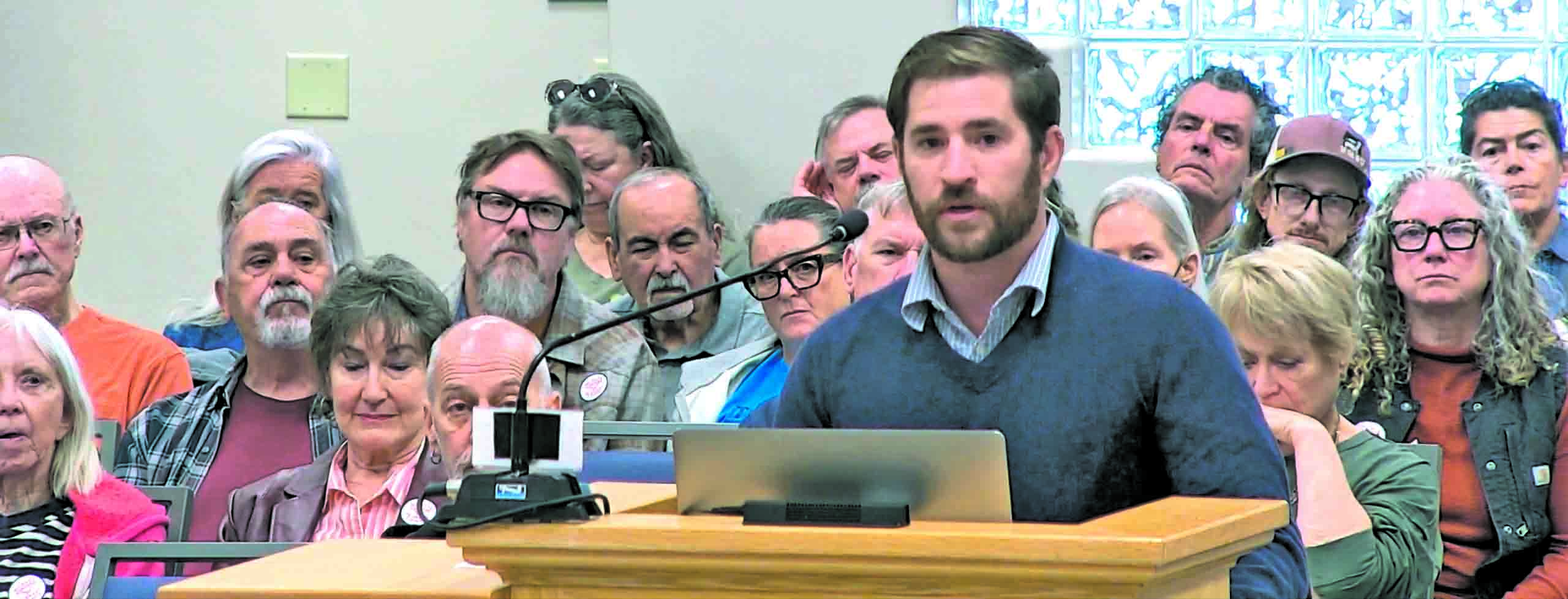
Blake Marcus, project developer for the Site Layer 1 project that envisions a solar and natural gas-powered data center in southern Grant County, appears at Thursday’s Grant County Commission meeting to plead unsuccessfully for commissioners to defeat a popular moratorium on data centers development — or at least exempt associated energy infrastructure that would connect to the grid. (Screenshot by Jo Lutz, Silver City Daily Press)