By Mia Casas, KUNM
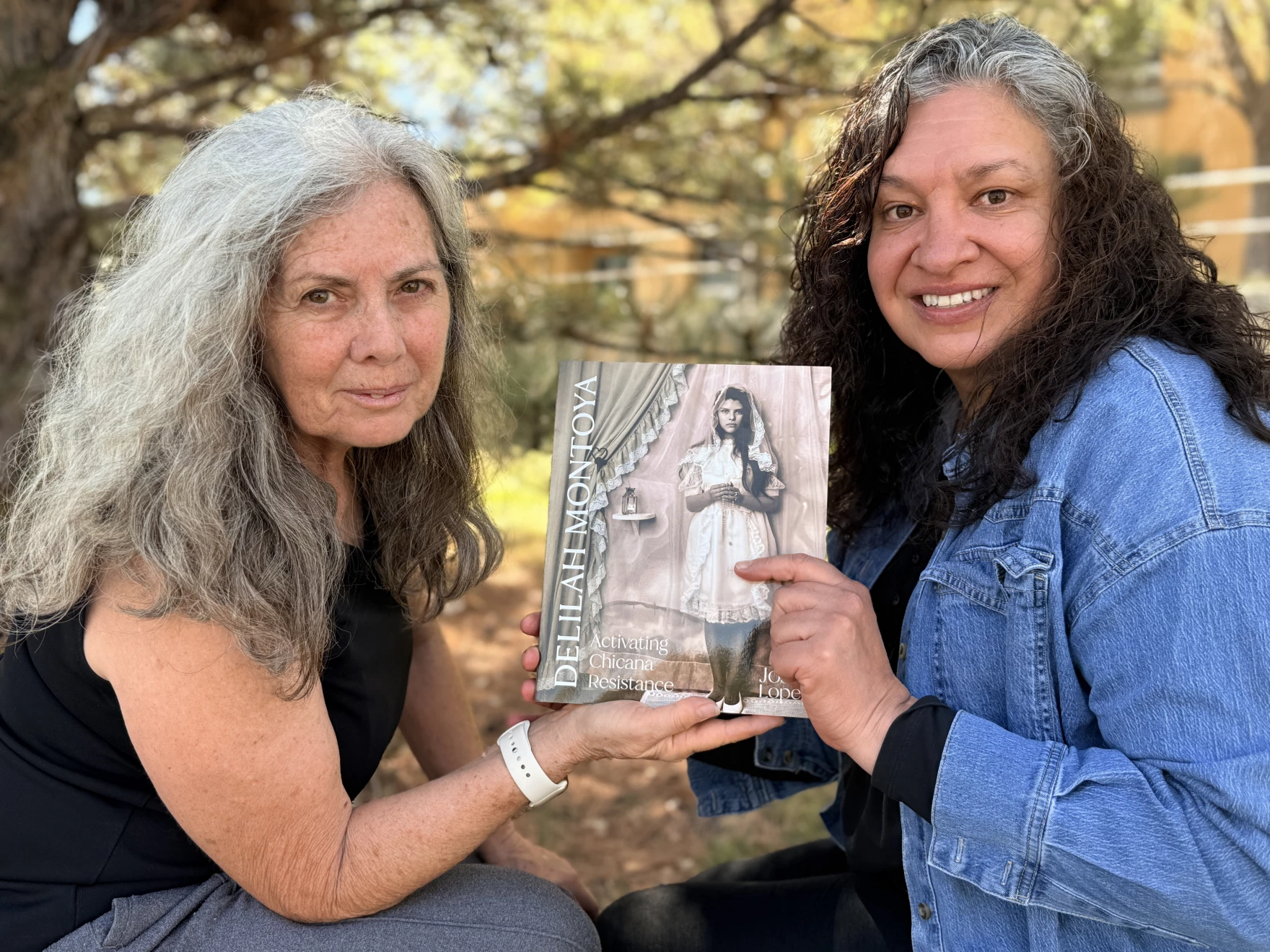
New Mexico artist Delilah Montoya’s major retrospective opened in February at the Albuquerque Museum. It encapsulates 40 years of activism based in photography, print making, and research. During the curation process, Montoya worked with art historian Josie Lopez on their new book Activating Chicana Resistance, taking a deeper look into Montoya’s body of work.
KUNM spoke with them both, starting with why Montoya wanted to finally put her work into written form.
DELILAH MONTOYA: For me personally, it was a way of just seeing all of the series come together. Because as an artist, you’re not really aware of the amount of time that you put into something. You don’t necessarily see the direction that you’re headed. It just kind of happens on a daily basis, one project at a time.Trying to get through how to figure this thing out, or how do I find the funding for this, or, you know, contacting the people I need in order to get this done. And so you never really look backwards.
I find that for me, it’s really difficult to pick up a project I let go of. I’m always moving forward. And I think artists are like that. We just continue to move forward and when you know, you get somebody like Josie who all of a sudden brings all of that, history, in front of you, you know, I had to look at it, and it just gave me kind of an awareness of what my world is, looking from the very beginning to where my last project was. There was a theme in there that never stopped. It was, it was always there. But what it did was it just, was all these branches that started kind of coming off of it.
KUNM: Josie, you are a renowned art historian who has been curating many exhibits for years around New Mexican and Chicana culture and activism, the partnership between you and Delilah seems just like a perfect fit. But why did you want to tell this story?
JOSIE LOPEZ: It’s way overdue, right? One of the things that I was working on when I was the head curator at the Albuquerque Museum was assessing the collections. Part of my job was to build and think about the collections in different ways. And at the time, I really felt like I wanted to create a data-driven collections plan, and so we did a demographic analysis of the collection, and it turned out that Chicanas were the least represented group in that collection. Now in my mind, that doesn’t sit well as a Chicana myself who is from New Mexico and whose family has been here for, you know, many, many generations, I felt like I wanted to do something about that, and the person who is one of our most renowned artists in Albuquerque is Delilah.
KUNM: Josie, tell me about the process of creating “Activating Chicana Resistance.”
LOPEZ: You know, I’ve been thinking about and looking at the art history of New Mexico for a very long time. It’s really embedded in a lot of my work. Like Delilah, I really like to dig into, you know, what are the roots of these projects, or how has a particular artist entered into a dialogue through their work? And for me, personally, I really have worked with a lot of artists who are activists. Before this, I did another project called Broken Boxes: Decade of Art, Action and Activism. And so after having done that, I was really thinking about some of the lessons I learned and how we created that catalog, and I brought some of those ideas also into the conversations with Delilah. Because again, you know, these artists, who are activists, are really thinking and engaging with not only history, but what’s happening now. So all of that was important to me.
The other aspect of this project is that there have been a few scholarly treatments of Delilah’s work, primarily presenting her as a photographer. And I had the great opportunity to spend a lot of time with her. And so I wanted to challenge that a little bit, and I wanted to show that, you know, she’s a printmaker, she’s an installation artist, and, of course, an activist.
And then, of course, it had to be something that’s accessible, right? Because in academia, a lot of time we’re writing things that are not necessarily accessible to the communities that Delilah is making work with and for. So we wanted to be sure that there were stories in there that the community could look at and say, ‘oh, there’s my uncle or my brother’ or whatever. And for me, it was important to do each of those things well, and to make sure that this project was going to be something that was not only going to celebrate Delilah, but that it was going to be a record, so that when other scholars and art historians come back to look at her work, then we have her voice represented in that scholarship.
MONTOYA: I think the catalog does that very well. I think we touched on a lot of the issues I was thinking about. I was really thrilled to have process brought in, because so much of the time people don’t quite understand the kind of process that I’m doing in order to make the work and the process is actually very important to the work itself.
KUNM: Josie and Delilah, what do you hope people will get out of this book and out of the retrospective?
LOPEZ: I think that this exhibition is an amazing way to delve into the understanding that you know, Latinos are varied and diverse, but we’re also connected. And there have not been a lot of major exhibitions like this of Chicana artists. And so to be able to really highlight Delilah’s work in this way, I think is another important aspect of what this project represents on a larger scale.
MONTOYA: And that also brings up the truth, right? That Chicanas never get recognized until they kind of die. And so I guess when I look at this, I’m like, “man, I’m alive to see it!” Thank you Josie.
LOPEZ: No, of course!
The retrospective exhibit, Activating Chicana Resistance, is up at the Albuquerque Museum until May 3 and the book is available now.