By Maddie Carr
Statehouse Reporting Project
Over half of candidates in governor’s races across the country in 2026 have aligned on one key issue in the contentious debate over data centers — there must be rules in place on how facilities consume energy.
Some have argued data centers must cover the total cost of their energy needs. Others add that they should build their own power generation or expand state energy resources. The issue is top of mind as residents grow concerned over rising energy prices linked to data centers.
“My bar is simple: No new data center should be approved if it raises electricity costs on everyday Alaskans,” Jonathan Kreiss-Tompkins, the Democratic hopeful for Alaska governor, told the Alaska Beacon.
Other actions that would limit or delay data centers — from moratoriums on construction to eliminating tax breaks for the companies that build them — have become increasingly popular among gubernatorial candidates of both parties as Election Day nears and public sentiment sours on the centers.
While Democrats tend to be more prevalent on the anti-data center bandwagon, more Republicans are joining the movement.
“I’ve called for a moratorium on new data centers in the state of Iowa,” Zach Lahn, the Republican running for Iowa governor, said during an August candidate forum. “And I don’t think that’s a radical idea. It’s a very simple idea. Just pause. Set the rules of the game.”
A team of reporters from the Statehouse Reporting Project examined public comments, news reports, debates, campaign material and email responses to gauge how some candidates for governor are addressing the issues ahead of Nov. 3.
In addition to finding more candidates taking stronger stands on slowing the growth of the centers, the research shows that a number of candidates are taking vague positions, making general comments about supporting “guardrails” on development without stating what those might look like.
Growing data center development has transformed the topic from a largely conceptual controversy into a tangible political dispute, according to Matt Harris, an associate professor of political science at Park University in Parkville, Missouri.
Democrats are more likely than Republicans to view the facilities as negative, but their unpopularity is growing more bipartisan, according to a survey by Pew Research Center published in September.
“I think data centers are probably more important now as an issue than they were even six months ago,” said Harris, who studies American politics and political campaigns.
Data centers reach across the aisle
Sixty percent of Americans wouldn’t be comfortable living near a new data center, and 54% said they are “mostly bad” for the environment. The opposition has resonated with officials in several states, who have taken action to crack down on the facilities.
New York became the first state to pause data center development statewide in July. Gov. Kathy Hochul, the Democratic incumbent, enacted a one-year moratorium on new projects through executive order.
Over a third of candidates have vowed to implement the state-level measure as governor, though by a slim margin, including Kansas Democratic state Sen. Cindy Holscher and Ohio Republican entrepreneur Vivek Ramaswamy. Ramaswamy has pledged to implement a moratorium his first day in office until lawmakers pass data center legislation aligned with his policy objectives on electricity bills, property taxes and environmental standards.
Dan Cox, a Republican from Maryland and a former state delegate, has gone further, saying he would work to permanently ban the facilities.
“I’m calling for an immediate statewide ban on new mega data center approvals while we push to enact the permanent ban,” Cox said on Oct. 21.
In June, incumbent Arizona Gov. Katie Hobbs, a Democrat, signed a budget bill that halts the state’s tax exemption for data centers through 2029. New Jersey’s End Data Center Tax Credits Act, a bipartisan bill, ended $250 million in unallocated tax incentives for the projects.
Oklahoma’s Data Center Customer Ratepayer Protection Act, signed into law by Republican Gov. Kevin Stitt in May, requires new data centers and other large energy users to pay for their energy and infrastructure needs.
Republican Sen. Tommy Tuberville, who is running for Alabama governor, co-sponsored the federal Ratepayer Protection Act in the Senate, which would encourage states to adopt a federal standard requiring large load facilities to cover the total amount of their energy costs to protect consumers. The House version of the bill failed in the Senate.
Data centers in Alabama would be required to pay the full cost of their electricity and water infrastructure and replace the water and power they consume under Tuberville’s administration, he said in an op-ed published in the Alabama Political Reporter in September.
“They can build their own power generation or pay into a fund that expands Alabama’s energy capacity and lowers costs for our people,” he said. “Data centers should leave Alabama’s infrastructure stronger than they found it.”
Jerri Green, the Tennessee Democratic candidate for governor, expressed a similar fair-share sentiment in a post to her Substack on Aug. 17. Green is challenging Republican Sen. Marsha Blackburn.
“If a data center requires massive new electrical infrastructure, the company creating that demand should pay its fair share. Tennessee families shouldn’t see their utility bills increase to subsidize some of the world’s wealthiest technology companies,” she said.
Blackburn agrees ratepayers should be shielded from additional costs. She’s called for “thoughtful” decisions about the location of the centers, but supports their continued development.
“Data centers are going to be a good and important part of Tennessee’s economic growth,” Blackburn said while discussing a controversial proposal that placed a data center near the Nashville Zoo. “But we’ve got to be thoughtful about their placement.”
Governors flip on data centers
As local opposition mounts, some incumbent governors have noticeably shifted within the last year on the benefits of data center development.
Oregon Gov. Tina Kotek, a Democrat, expressed support for a statewide moratorium on data centers during a Sept. 8 rally at the state capitol. In the past, Kotek emphasized local decision-making on data center pauses and not state-level intervention.
On Oct. 13, she ordered the Oregon Department of Environmental Quality to pause water and air discharge permit approvals for new and expanding data centers until July 2027. Her Republican challenger, Christine Drazan, is in favor of a temporary pause.
Josh Shapiro, the Democratic governor of Pennsylvania running for reelection, also walked back his earlier sentiments of support for the facilities. At a press conference on June 9, 2025, Shapiro touted Pennsylvania as the future of AI growth and data center development during an announcement of a $20 billion data center investment from Amazon.
“We can produce enough power to support the energy intensive supercomputers and server farms of Amazon’s data centers … while still delivering reliable, affordable energy to small businesses that line our mainstreets to our families and right into their living rooms. I’m an all-of-the-above energy governor,” he said.
But in August, Shapiro signed an executive order for what he calls the “strictest guardrails in the nation” to crack down on the industry.
The order did not issue a moratorium, but it did remove AI data centers from the fast-track permitting process and required them to have local approval before the state reviews a permit application. It also mandated the state’s requirements for responsible infrastructure development, known as GRID, become part of the permitting process for data centers. The GRID standards subject data centers to annual public reporting of water usage and energy metrics.
Less than a quarter of candidates have said whether they would require similar public reporting measures for water use.
“A moratorium is a timeline to get to a policy. I put in place the strictest policy, the strictest guardrails, in the nation to ensure that our communities are protected,” Shapiro said during an Oct. 8 debate with Republican challenger Stacy Garrity, who supports issuing a moratorium. “Again, to put it simply, if a local community does not want that data center to be built in their community, it will not be built.”
Perhaps nowhere is the data center flip-flop more evident than in the Lone Star state, where Republican Gov. Greg Abbott has quieted his once loud support of the facilities.
After announcing a $40 billion investment from Google last November, Abbott boasted that Texas had become the “epicenter of AI development.” Part of that investment involved data center development to bolster AI infrastructure. Since then, Abbott has changed his tune. He’s ordered a series of audits and permit pauses that together, in effect, have halted data center developments in the state.
“They basically dug their own grave for the problem that’s been caused for them, and that’s why they got the backlash they deserve,” Abbott told ABC’s “This Week” during an Aug. 23 interview.
Earlier that month, he ordered an audit of some large-load data center facilities seeking to connect to the state’s power grid. He later expanded the crack-down in September by halting all permit approvals for data center projects during the audit.
The flip-flop has gained backlash from the incumbent’s challenger, Democratic legislator Gina Hinojosa.
Hinojosa has called Abbott’s moratorium a “scam”, saying he will lift it after the election. She pushed him to enact a moratorium until legislative guardrails are in place. She’s also called attention to Abbott’s pivot on tax incentives for data centers.
“Greg Abbott’s moratorium on data centers is just words,” she said during a press conference in Dallas on Oct. 13. “We still have Texans who are up against these big economic powers in our communities that are having to fend for themselves because Greg Abbott invited the data centers into Texas with the richest tax breaks in the whole country.”
In 2015, Abbott approved a 20-year sales tax exemption for qualifying large data centers, before the AI data center boom. He said he’ll work with the Texas Legislature to repeal financial incentives during the 2027 legislative session.
How will it play out during the election?
Data centers have become a volatile issue in New Mexico. It is the landing pad for Project Jupiter, a data center facility under construction in Doña Ana County. The project has faced a mountain of backlash over its environmental impact on water and air quality.
“The moratorium is the one that is going to get the most traction with voters” said Gabriel Sanchez, a professor of political science and director of the Center for Social Policy at the University of New Mexico.
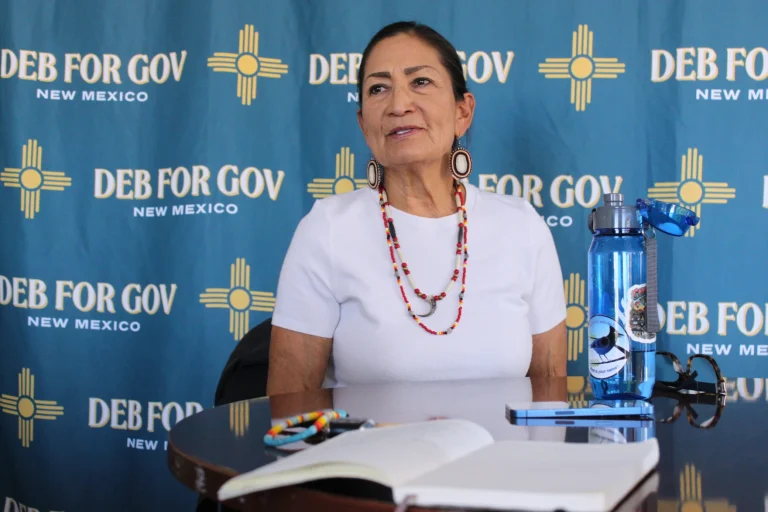
Democratic nominee Deb Haaland, the former secretary of the interior under the administration of former President Joe Biden, has called for a statewide moratorium to establish measures that protect local communities, the environment and hold the industry accountable.
Her opponent, Republican Gregg Hull, is more open to data centers, calling for “guardrails” but not “roadblocks.” The state shouldn’t shut out economic development opportunities completely, he said. He opposes a pause on data center development.
“I think a lot of New Mexicans are a little bit hesitant on any of these ventures because they’ve seen how a lot of these things don’t lead to as much good as they’re promised,” Sanchez said.
Harris said the importance of data centers in the political landscape will grow over time. It’s a matter of more people feeling the effect and developing opinions.
While the partisan line remains more muddy than it is clear, he expects more clarity to emerge over the next few years.
“I would imagine (data centers) will be a more important issue in 2028 and maybe even more so after that,” Harris said.
The effect of data centers on the midterms will likely remain limited in 2026, Harris said. They may carry more weight in states with close races, but in others, the cost of living and inflation will be more important to voters.
“People have opinions on data centers,” Harris said. “They’re largely negative. But if you rank the issues in terms of importance, it’s probably not super high on that list, unless you live somewhere where they’re proposing building a data center right next to your house or in your town or something like that.”
This story was reported by Maddie Carr, a reporter and journalism master’s student at the University of Missouri. Max Ulz of the University of New Mexico, Bria Demand, Conor Sexton and Natalie Keller of the University of Kansas and Devin Kraber, Hudson Kuechler and Jackson Cooper of the University of Missouri contributed reporting. Twenty-nine students from the University of Missouri and the University of Kansas and one student from the University of New Mexico collected candidate information.
Methodology
By Maddie Carr, Statehouse Reporting Project
The Statehouse Reporting Project sought to determine the views of candidates for governor on the issue of data centers by contacting each campaign and reviewing candidate campaign websites, press releases, debates, news articles, campaign ads, votes on legislation, governor websites and public comments.
The project looked at major candidates, defined as those polling 15 percent or more in polling data for the 36 gubernatorial races. Each candidate was evaluated on data center topics including support for state-wide moratoriums, public water-use reporting and regulatory frameworks.
A candidate’s position was considered unclear on an issue if they did not respond to our email requests and their stance was not addressed in public comments or voting records.