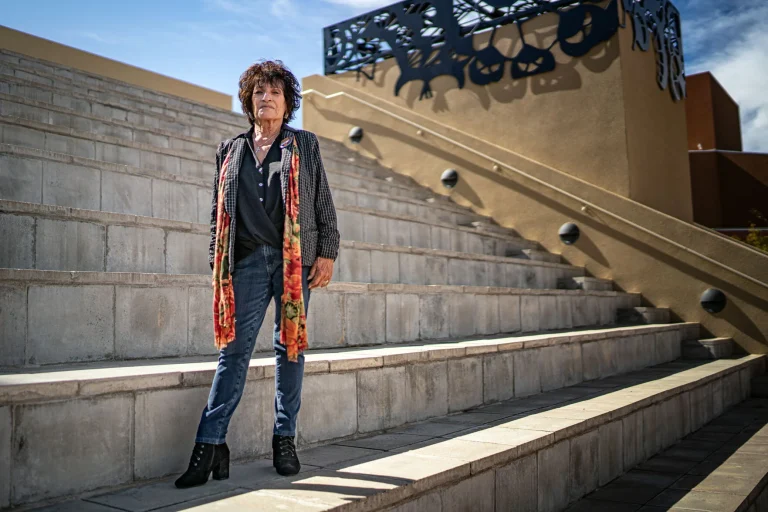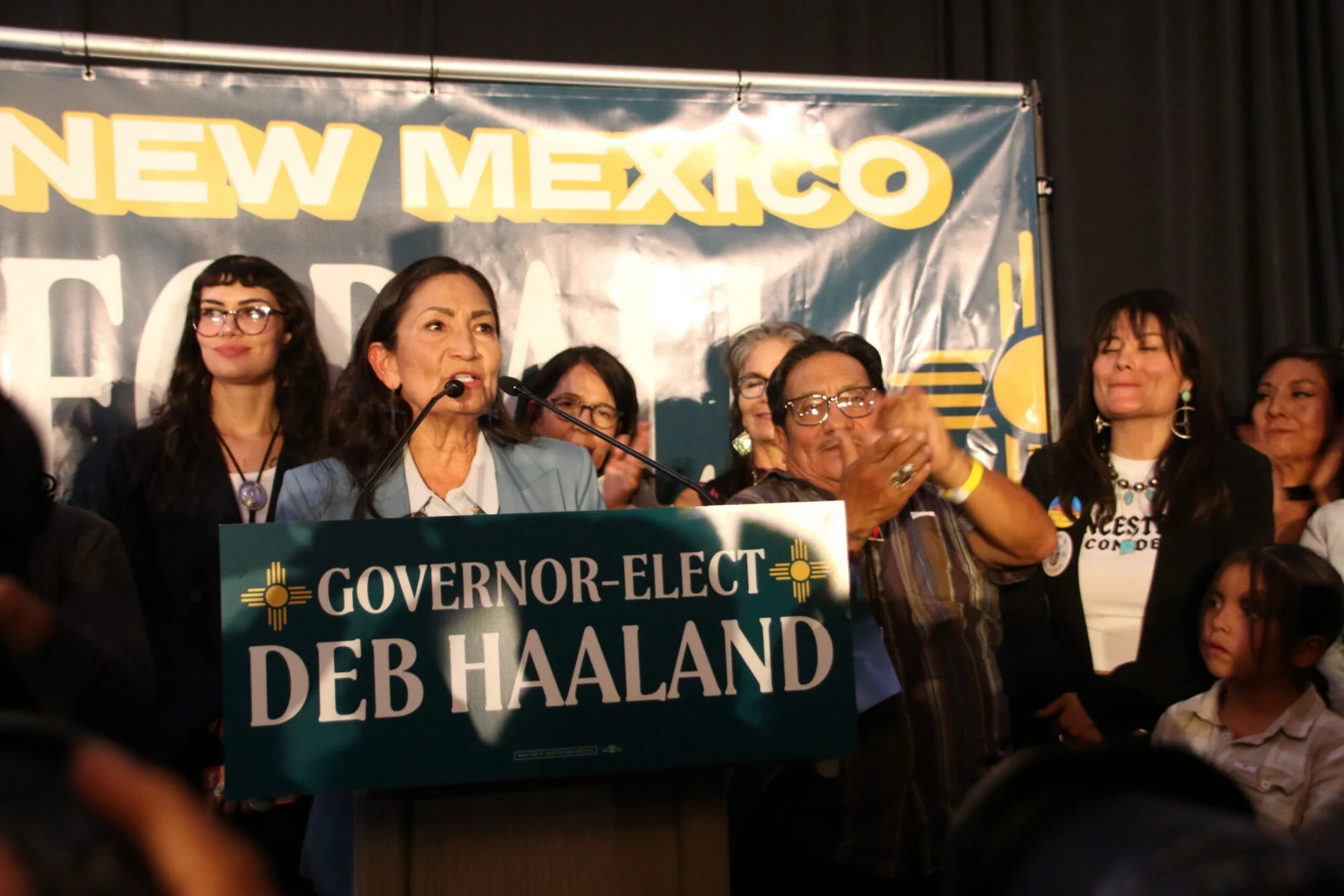
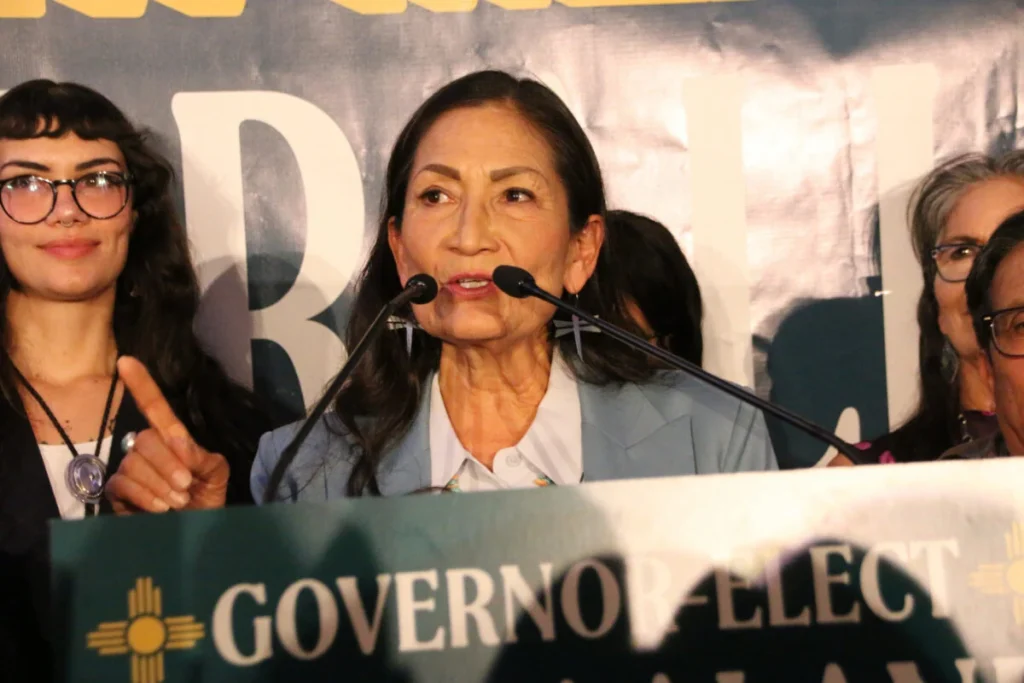
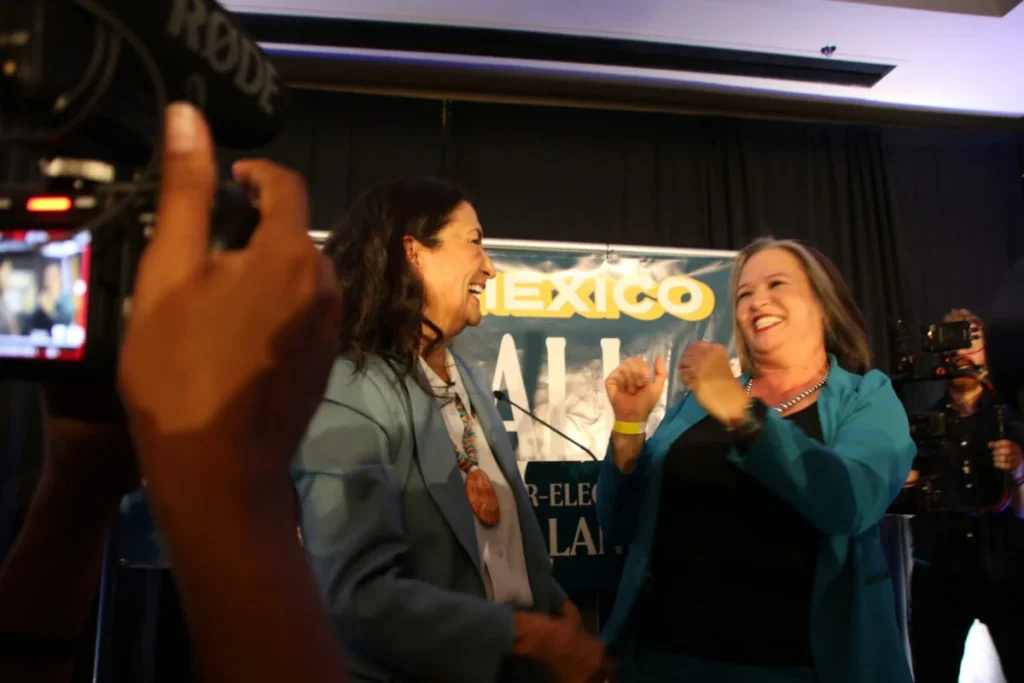
Deb Haaland, an enrolled member of Laguna Pueblo who describes herself as a 35th-generation New Mexican, made history Tuesday as the first Native American elected governor of New Mexico in its nearly 115 years as a state and the first Native American woman elected governor of any U.S. state.
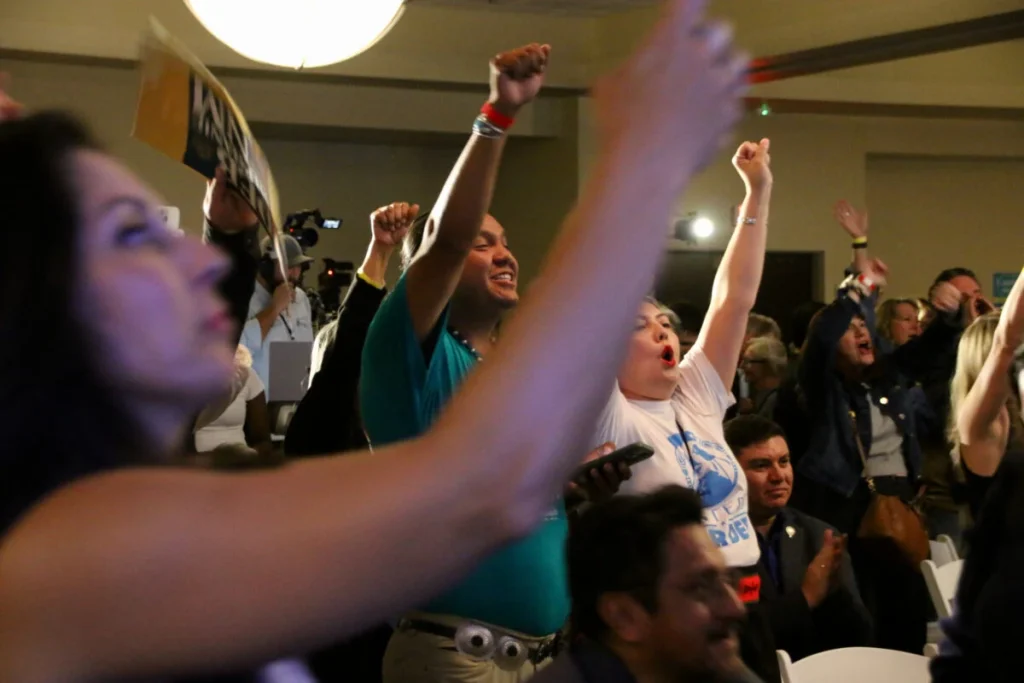
“In our nation’s 250th year, I stand before you as the first Native American woman…” she said Tuesday night before being drowned out by an ecstatic crowd of hundreds at Laguna Pueblo-owned Route 66 Casino Hotel west of Albuquerque. “It’s not only about history. It’s about our future.”
Powered by a tsunami of fundraising that shattered the state’s previous record for a gubernatorial candidate and a national profile burnished by time as a member of Congress and as U.S. Interior secretary, Haaland, 65, defeated Republican Gregg Hull, a former Rio Rancho mayor.
Haaland ran for governor largely on an affordability agenda. She’s proposed creating a public health insurance option, raising the minimum wage, building more housing and investing in renewable energy to create jobs and lower energy costs. And she’s vowed to issue a pause on new large-scale data centers.
A constant undercurrent of her campaign — felt strongly by supporters like Graham Beyale (Diné) — was that New Mexico could elect its first Indigenous governor.
Before saying on Tuesday night why Haaland’s election means so much to him, Beyale warned he might cry.
“I keep thinking about what an Indigenous-led state of New Mexico would look like,” said Beyale, who’s from Shiprock on the Navajo Nation. “I think the suppression of Native voices has always been at the forefront of what the United States is, and this is resistance. This is the precipice of change.”
Beyale, a farmer and the owner of a small business called Biyáál Trading Post, planned to spend the run-up to Election Day volunteering for Haaland’s campaign. Then historic flooding hit northern New Mexico. He’s been consumed with helping people and animals evacuate and distributing donations.
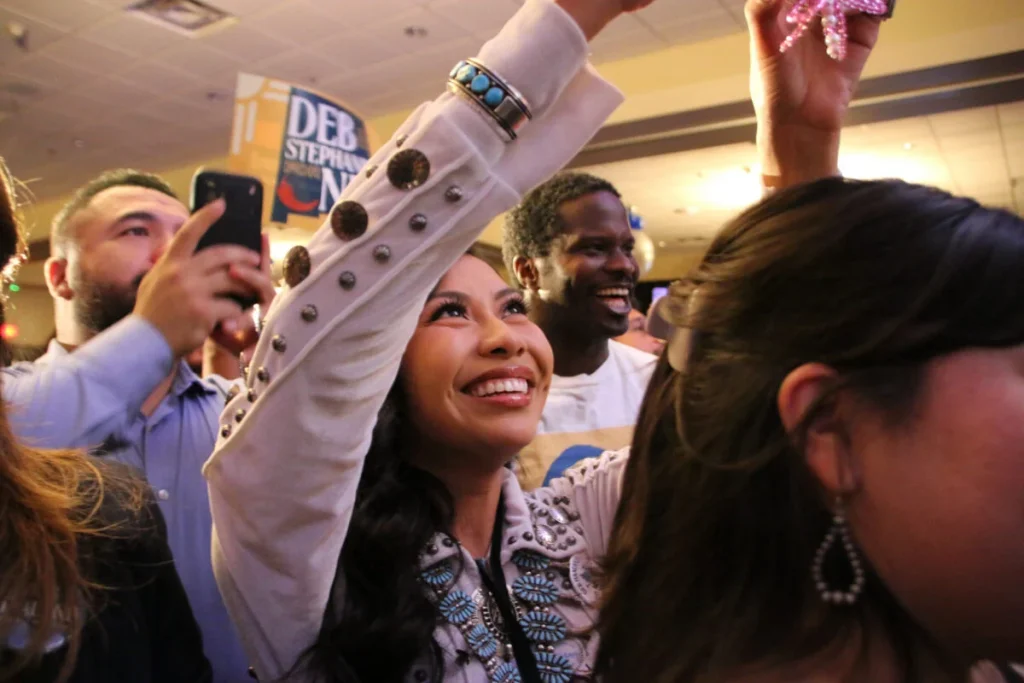
But on Tuesday, he made the three-hour drive south to the casino hotel to see Haaland. At about 7 p.m., as the polls closed, he sat in the election night party crowd documenting what he was seeing and feeling in a notebook.
Haaland’s win sends a clear message about Indigenous people, Beyale said: “We’re not gone. We’re thriving. We’re bringing who we are as Indigenous people, our knowledge, our culture, our history, to the forefront.”
Her victory marks yet another first in a political career full of them.
In 2019, Haaland became one of the first two Native American women elected to Congress. And in 2021, she became the first Native American to serve as a U.S. Cabinet secretary, nominated by President Joe Biden and confirmed by the Senate.
“Representation matters,” Haaland said in an Oct. 24 interview with New Mexico In Depth, a little over a week before her win. “It matters in this political era that we’re in, it always matters, and so I hope that I can bring a perspective to the governor’s office, if I’m elected, that hasn’t necessarily been brought before.”
Over 12% of New Mexico’s residents are Native American, one of the highest shares of any state, compared to the nearly 3% of the country’s population who are Indigenous, according to the 2020 census.
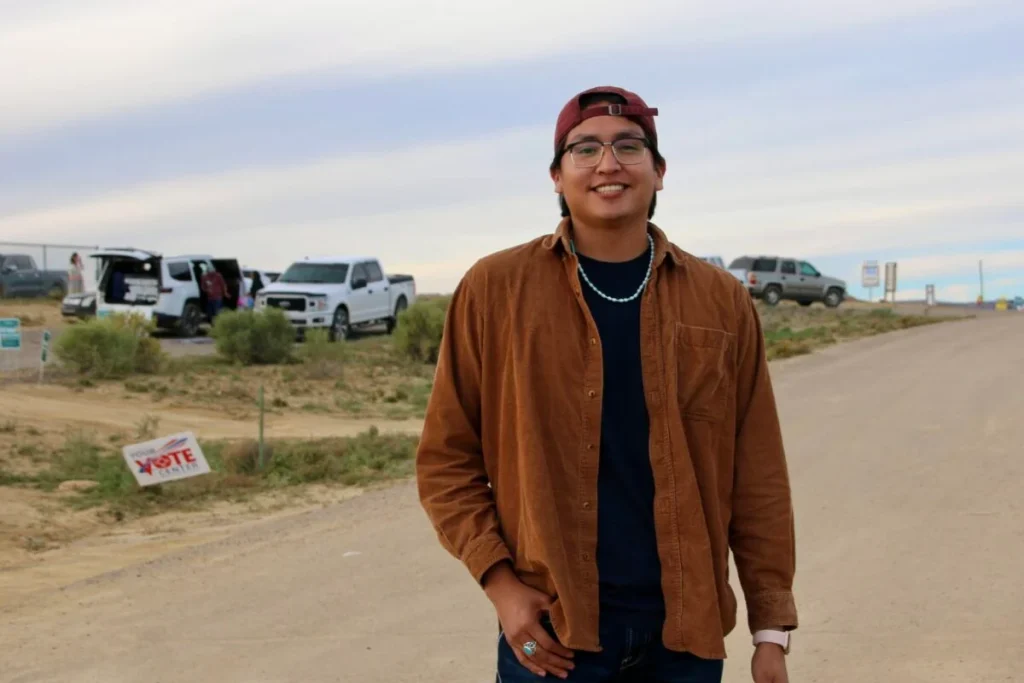
“I voted for Deb because, to me, it’s about representation,” said Joey Chavarillo (Diné/San Felipe Pueblo), who on Election Day was set up outside a polling site in To’hajiilee — on the Navajo Nation, about 15 miles from the casino hotel — to campaign for an uncle running for a seat on the Navajo Nation Council. “I’m Pueblo, she’s Pueblo. Even though we’re not related, there is some sort of relation. All Native people, we’re related. So it’s pretty big. It’s empowering.”
It was doubly meaningful to vote for an Indigenous woman, he said, adding Haaland’s election will encourage Native kids everywhere to start picturing themselves in leadership positions.
Theresa Pasqual (Acoma Pueblo), who formerly directed Acoma’s historic preservation office and served as a voter registration coordinator for Cibola County, hopes that’s true.
“I hope that it inspires more generations of young people, especially in our tribal communities, our Pueblo communities, to say, ‘I too can make a difference,’” said Pasqual, who volunteers as a poll worker.
Haaland has already had that effect.
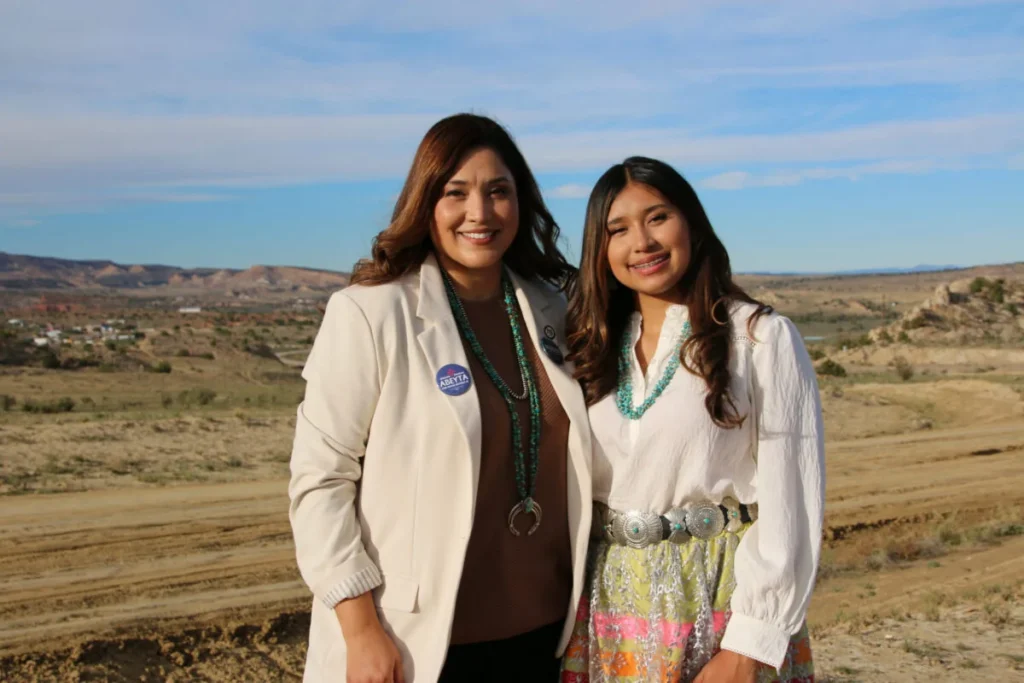
During Haaland’s run for New Mexico lieutenant governor in 2014, which ultimately proved unsuccessful, Michelle Paulene Abeyta (Diné) sent her an email asking how she could help. She expected Haaland to tell her to volunteer or donate, but instead, Haaland told her to run for office.
Within the next couple years, Abeyta ran for school board in To’hajiilee, and she served on the board for years before being elected to the state Legislature in 2024. This year, she beat her opponent in the Democratic primary and ran uncontested in the general election for New Mexico House District 69.
“When I was collecting petition signatures the first time I ran,” Abeyta said, “I had asked a relative, ‘Can you please sign my petition? I’m running.’ She said, ‘What is this? Is this some kind of Deb Haaland thing?’ And I said, ‘What do you mean by that?’ She’s like, ‘Well, aren’t all Native women running for office now?’ And I was like, ‘Yes, it’s exactly a Deb Haaland thing.’”
Abeyta spent Nov. 3 outside the To’hajiilee polling site with her 15-year-old daughter Hailey and other family, making frybread for voters and welcoming Haaland during a brief campaign stop.
“This is the first Native American getting elected as governor, and it’s so cool because she’s not forgetting where she came from,” Hailey said.
Native peoples in the region governed themselves for thousands of years before New Mexico gained statehood in 1912. Today, New Mexico shares borders with 23 tribal nations — 19 pueblos, the Navajo Nation, the Jicarilla Apache Nation and the Mescalero and Fort Sill Apache tribes. Together they speak eight languages and maintain distinct cultures and governments.
They share a history of being largely excluded from the state’s political process.
Despite gaining U.S. citizenship in 1924, most Native people couldn’t vote in state or federal elections in New Mexico for years afterward. Miguel Trujillo, a World War II veteran from Isleta Pueblo, successfully sued for that right in 1948 — only a dozen years before Haaland was born.
Haaland grew up in a military family that moved often, but she spent summers in Laguna Pueblo helping her grandfather tend his cornfields and preparing the food with her grandmother.
Values learned during those times will shape how she governs, she said in her late October interview after touring a veterans’ center in Albuquerque.
“Feeling like you’re really honoring the earth with the gifts that it gives us, that is a perspective that I think is really important right now in this climate crisis,” Haaland said. “I just understand how important it is to think about what New Mexico has and how we can protect it and honor it, honor our natural resources, protect our natural resources, make sure that, as my ancestors did for me, making sure that future generations have what they need to thrive here.”
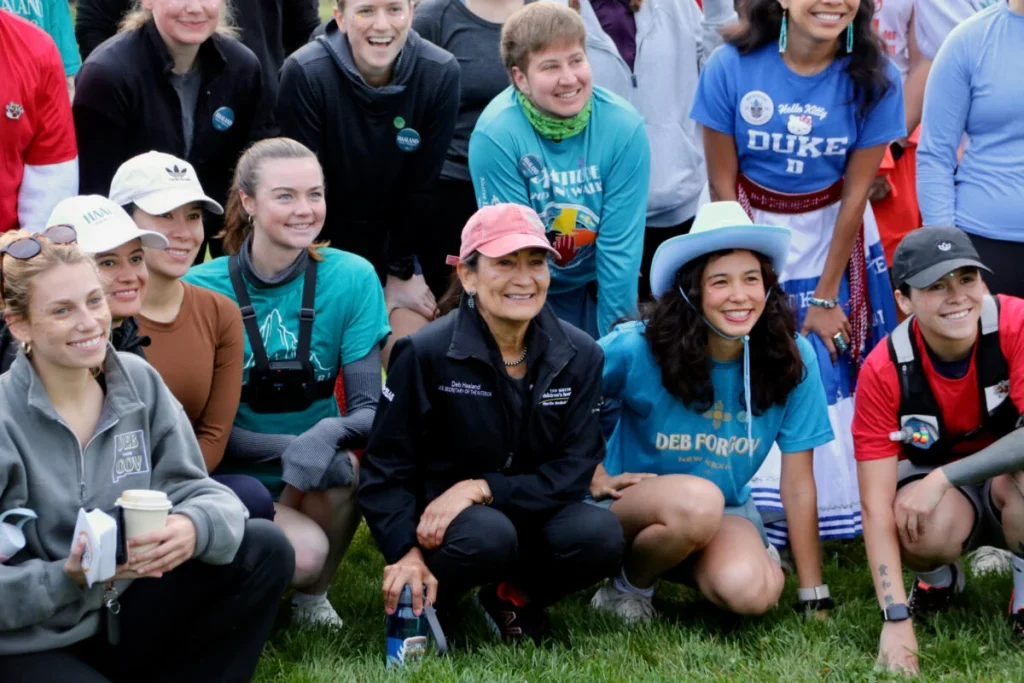
Earlier that October day, Haaland ran a three-mile loop in the North Valley with a local run club. Before setting off, the runners gathered at an art market, where Haaland browsed a jewelry stand run by a 74-year-old Diné man and his family.
Later, the man, who asked to not be identified by name during an interview with New Mexico In Depth, described being taken from his home when he was six years old and sent to an Indian boarding school designed to strip Native children of their cultures and take away tribal lands.
He appreciated Haaland’s investigation of the schools as interior secretary, he said.
“She’s broken down a lot of barriers,” he said. “We finally get a voice in the politics of the state.”
It’s personal for Haaland, too. Her great-grandfather attended Carlisle Indian Industrial School — whose founder coined the phrase “kill the Indian [in him], and save the man” — in Pennsylvania, and her maternal grandparents were taken from their homes and sent to boarding school.
The legacy of boarding schools looms large in New Mexico. Of nearly 1,000 children who died in the schools nationwide, at least 95 were at schools in the state, according to an Interior report issued during Haaland’s tenure. A later Washington Post investigation found over 3,100 children died at the schools, though some historians believe the death toll is far greater.
“My grandparents’ generation, they suffered from so many of the assimilation policies of the United States, and when I think about how fiercely they protected our customs and traditions, it just makes me really grateful,” Haaland said in her interview.
Born in Winslow, Arizona to parents who were both U.S. service members, Haaland graduated from Highland High School in Albuquerque. Later, as a single mother, she’s said she lived paycheck to paycheck and was at times homeless while raising her daughter. Those experiences, she’s argued, help her to understand the needs of many New Mexicans who have similarly struggled.
Before politics, she was a tribal administrator for San Felipe Pueblo and chaired the board of the Laguna Development Corporation.
Early in her political career, about 20 years ago, she went through a leadership training program run by the New Mexico chapter of Emerge, a national organization dedicated to getting Democratic women elected to public office.
“I was in the room when she did her very first stump speech,” said Anathea Chino (Acoma Pueblo), the former president and one of the founding board members of Emerge New Mexico and now the executive director of Advance Native Political Leadership.
Chino never doubted Haaland would be where she is now, she added.
“And as a Pueblo woman, to be able to see a sister in a position like this has just been profoundly impactful in my life,” Chino said.
After the unsuccessful run for lieutenant governor in 2014, Haaland was elected to chair the New Mexico Democratic Party by its members, making her the first Native American woman to lead a state party.
Donald Trump’s reelection in 2024 motivated her to run for governor, Haaland told the run club.
“I feel we need someone who can push back against all these horrible policies that we know are harming our grandparents, harming our grandchildren, harming each other,” she said, pointing to estimates from state officials that 89,000 New Mexicans could lose Medicaid coverage because of new federal eligibility requirements.
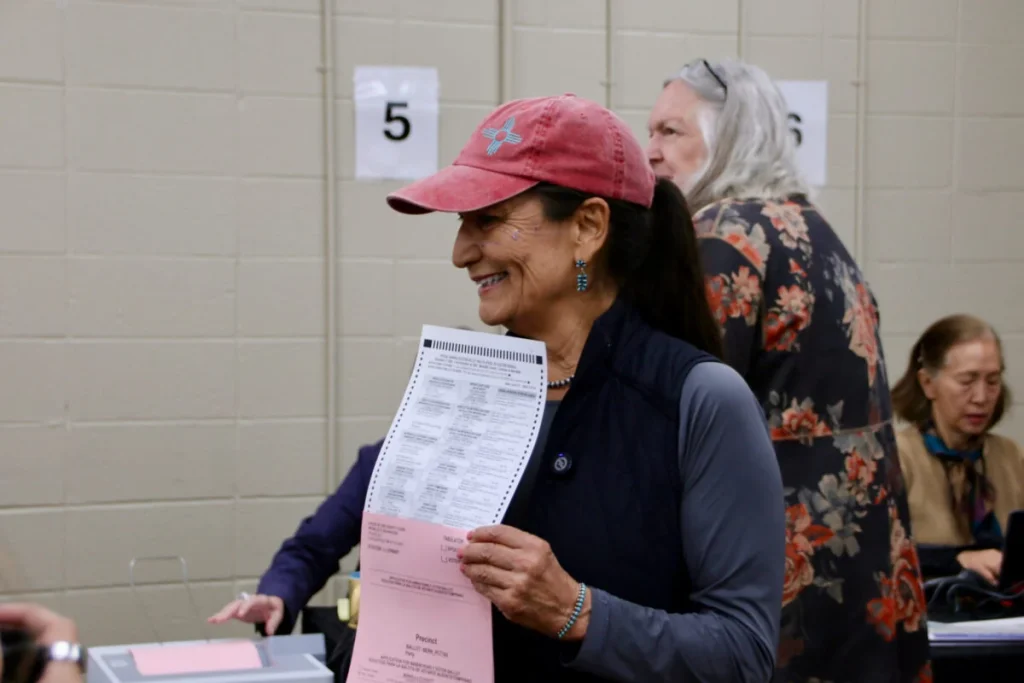
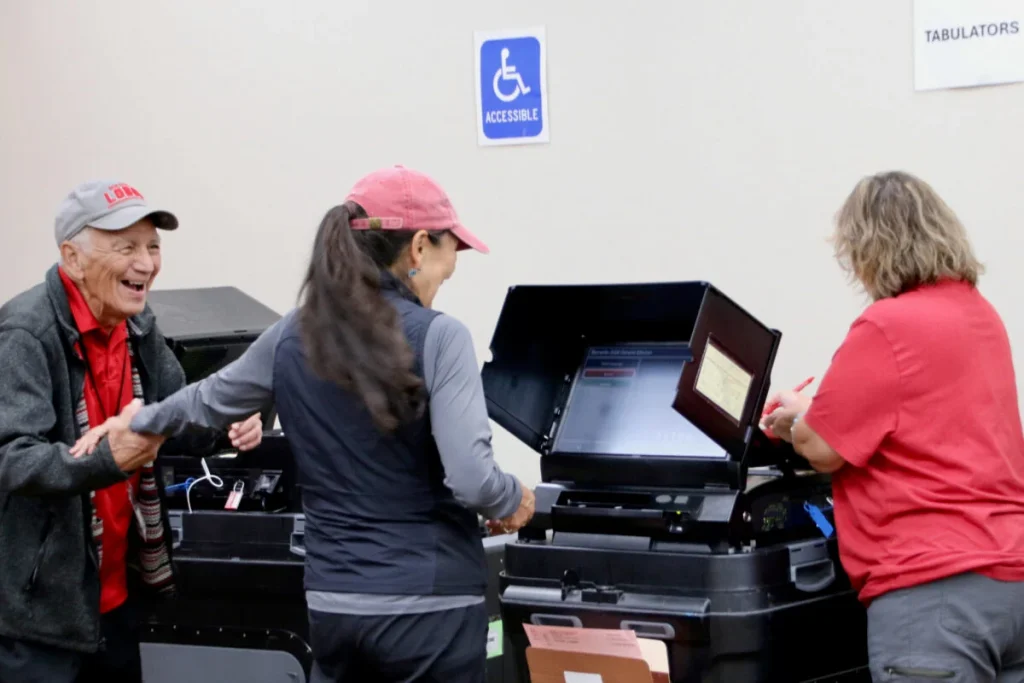
For all the excitement, some Native voters are skeptical. Take Janice Lente (Isleta Pueblo), who cast her ballot on Election Day at Isleta’s elder center.
“I was trying to research [Haaland] to see the things that she’s done, and while she was in D.C., I did see she did a lot of things there. But as far as here in New Mexico, I haven’t seen a whole lot from her,” Lente said.
Still, she didn’t struggle much when deciding how she’d vote.
“I will not vote for anybody that’s with Trump,” Lente said.
One issue on her mind is how much costs for essentials have risen, she said, and she’s troubled by how many Native people experience homelessness.
Pasqual, of Acoma Pueblo, wants Haaland to work closely with tribal leaders to tackle disparities in education and healthcare, among other challenges.
“Certainly there’s no perfect, 100% ideal candidate that exists, because they’re human,” Pasqual said, “but I see it as an opportunity, a pathway to get front and center some of the issues, some of the concerns that are most central to our Pueblo communities, our tribal communities, communities of color.”
Change takes time, Pasqual said, but she’s excited about the possibilities.
“I would love if she did not lead a cautious administration,” said Chino, from Advance Native Political Leadership. “This moment is just way too big for that.”