By Bella Davis, New Mexico In Depth
As she was being sedated for a procedure following a miscarriage many years ago, Rep. Patricia Roybal Caballero was given several forms to sign. Her husband, she says, noticed a box that had been checked on one of the forms.
It was for a hysterectomy, which she wasn’t scheduled to undergo.
“Had my husband not intervened, I would not be the mother later in life of, now, a 38-year-old son,” she said.
Roybal Caballero, who is a member of the Piro-Manso-Tiwa tribe, shared her story of nearly being sterilized without consent during a Senate Indian, Rural and Cultural Affairs Committee hearing Feb. 3. She hadn’t spoken openly about it, she said, but was moved to do so after hearing testimony from other women with similar experiences during an interim committee hearing last year.
“It gave me courage to speak up on their behalf,” said Roybal Caballero, a Democrat from Albuquerque sponsoring House Memorial 32, which calls for a study of the scope and ongoing impacts of forced sterilization of Indigenous women and women of color and, later, the establishment of a truth and reconciliation commission. While it waits for a hearing on the House floor, the Senate on Saturday unanimously passed a mirror effort, Senate Memorial 14.
The memorial — which, unlike a bill, doesn’t have the force of law or require action by the governor — requests the Indian Affairs Department and the Commission on the Status of Women carry out the study and present their findings and recommendations to the governor and Legislature by the end of 2027.
New Mexico would be the first state to investigate or acknowledge forced sterilization of Indigenous women, according to Keely Badger, an international human rights attorney whose Oxford University legal dissertation examined the practice.
“There is now a global movement to bring the heinous nature of these acts globally to the forefront,” Badger told lawmakers. “Coerced and forced sterilization under international law is considered a crime against humanity and in certain contexts considered genocide, both biological and cultural genocide.”

In the 1970s, Dr. Connie Uri (Choctaw/Cherokee) concluded that one in four Native women had been sterilized without their knowledge or consent after reviewing the records of 26 of 35 Indian Health Service hospitals with obstetrics wards.
IHS is an agency of the U.S. government, which has a legal and moral trust responsibility to provide essential services including health care to tribal citizens. Uri then reportedly began to call the office of a U.S. senator who was the chairman of the Senate Subcommittee on Indian Affairs. In 1975, the senator requested the U.S. Government Accountability Office look into the allegations.
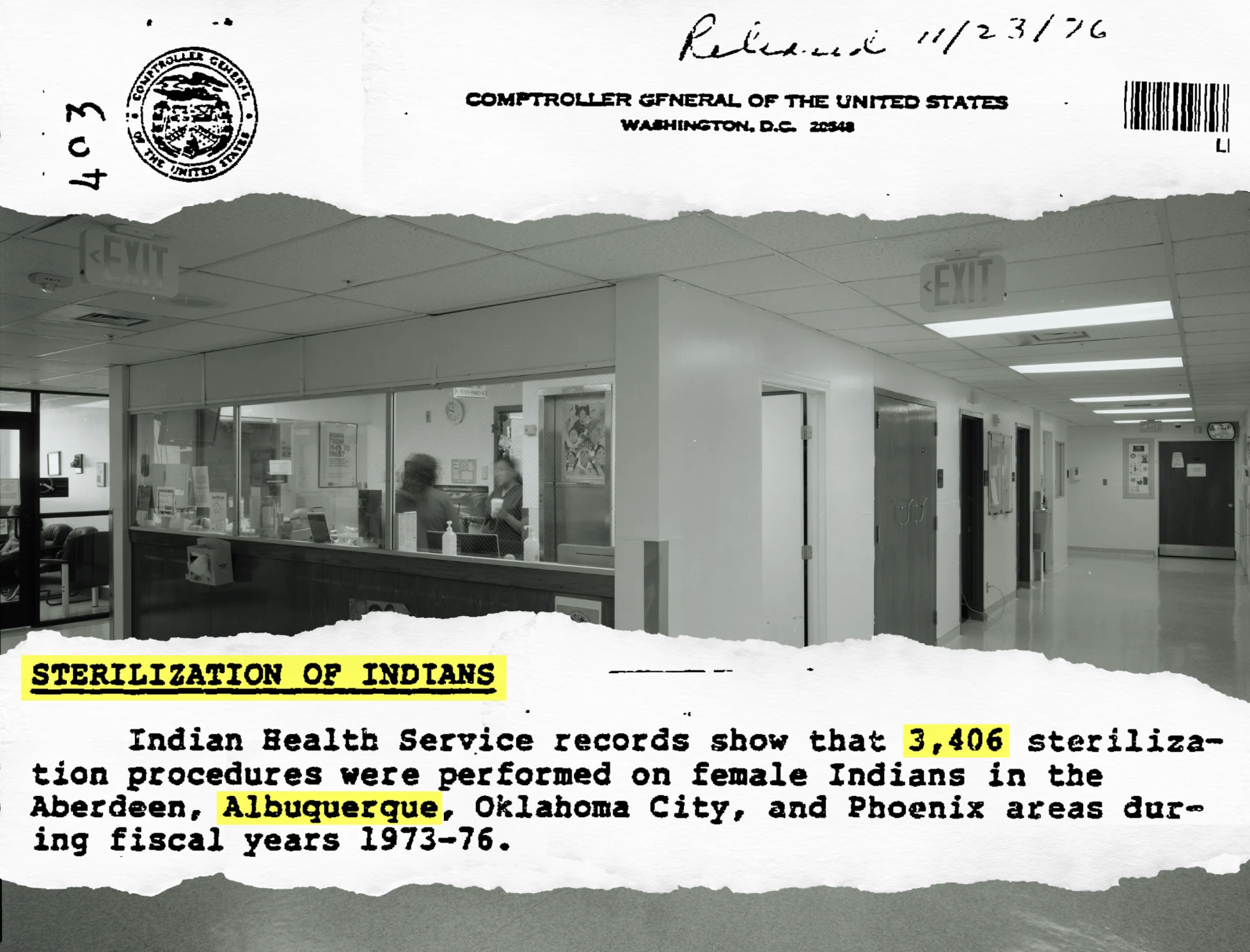
During a roughly four-year period in the 1970s, 3,406 women were sterilized at IHS contract facilities in four of the agency’s areas, according to a 1976 report by the office. The Albuquerque Area — which, while headquartered in the city, covers multiple states — was one of the four in which records were reviewed. Many consent forms the agency examined lacked key details required by federal regulations, such as statements that the procedures were voluntary. IHS officials in the Albuquerque Area “said that they do not monitor the adequacy of informed consent received by contract care doctors or facilities,” the report reads.
But in part because the review covered only a third of IHS areas across the country during a narrow window, how many more women were sterilized remains unknown.
Jean Whitehorse, who is Navajo, is one of them.
In the early 1970s, when she was 22, a ruptured appendix brought her to an IHS clinic in Gallup. While she was in pain waiting to be treated, Whitehorse was required to sign multiple documents, not knowing that one of them was for sterilization, she told lawmakers during the Feb. 3 hearing.
Whitehorse had one daughter at the time, but discovered later that the procedure at the Gallup clinic left her unable to have more kids.
“Women are the givers of life, but many women never had children. They never talk about forced sterilization that prevented them from having children,” she said. Whitehorse has testified about her experience at the United Nations Permanent Forum on Indigenous Issues.
Dr. Donald Clark, a family physician who is retired from IHS but continues to work in some tribal clinics, spoke about lingering fears during the public comment portion of a Feb. 6 committee hearing for the House memorial.
“This issue continues to come up sometimes in younger women and women who are in their 20s and 30s seeking contraception but not trusting that they will not be irreversibly sterilized because of what they’ve heard from their mother or grandmother or an aunt,” Clark said.
Supporters of the memorial said that forced sterilization itself isn’t confined to the past.
“I found out that just recently, most recently, there have been many cases that have been noted of this going on because of the language barriers, because of the poverty barriers, because women of color are vulnerable in these ways,” Roybal Caballero said Feb. 3.
A whistleblower complaint in 2020 alleged that migrant women being held at a Georgia detention center were subjected to gynecological procedures including hysterectomies without their consent. A subsequent U.S. Senate investigation reported “a catastrophic failure by the federal government” to protect the detained women.
In addition to the study, the memorial notes the Indian Affairs Department and the Commission on the Status of Women should make proposals for a truth and reconciliation commission; a statewide, Native-led reproductive justice program; a public memorial and education curriculum; and the state’s acknowledgement of “the inhumanity of the grievous policy of forced and coerced sterilization of Indigenous women and other women of color.”
Jenifer Raphael Getz, the executive director of the New Mexico Commission on the Status of Women, told lawmakers she believes the group is “uniquely suited to do this work” in partnership with Native-led organizations.
This story was originally published by New Mexico In Depth.