By Bella Davis, New Mexico In Depth
The Public Education Department should throw out its court-ordered plan for remedying inequities in how the majority of public school students in New Mexico are educated and start over. That’s what the plaintiffs in the long-running Yazzie/Martinez case told a state judge last week.
They’re asking the court to order PED to consult with experts in Native education, school finance, and other fields, along with tribal governments, to craft a new plan.
Almost all 23 tribes in New Mexico have also formally objected to PED’s plan, in resolutions and in letters sent to the judge. The All Pueblo Council of Governors, representing the 19 Pueblos in the state, wrote that the agency did not consult them about it.
In a Wednesday email to New Mexico In Depth, PED spokesperson Martha Pincoffs wrote the agency “rejects the premise that progress is stagnant” and that the plan is insufficient. The plan “builds on measurable momentum already underway,” Pincoffs wrote, pointing to investments in structured literacy that have “driven the highest literacy growth in New Mexico’s history” and legislative efforts to “achieve similar progress for math and special education.”
The plaintiffs, in a 53-page document outlining their objections, argue the plan “provides no credible basis to conclude” that New Mexico “will ever remedy the constitutional violations or extensive deficiencies” identified eight years ago.
The 190-page plan, submitted by the agency in November, doesn’t adequately tailor programs to each of the four student groups recognized as “at risk” in the case and doesn’t provide cost estimates for the actions it does propose, the plaintiffs wrote.
“Here we are in 2026, still looking for a comprehensive remedial action plan that would address the disparities affecting these four student groups,” Melissa Candelaria (San Felipe Pueblo), an attorney for the Yazzie plaintiffs, said in an interview. “And the plan that was submitted is fundamentally deficient.”
It’s been over a decade since parents and school districts sued the state for failing to provide a sufficient education to Native American students, low-income students, students with disabilities, and English language learners.
A state judge agreed in 2018, but PED never finalized a plan for righting that wrong.
The plaintiffs returned to court in 2024, arguing the agency hadn’t complied with the court’s previous rulings. Last spring, First Judicial District Court Judge Matthew Wilson ordered the state to develop a “comprehensive remedial action plan” that would give the Legislature and state executive branch guidance, “particularly when making difficult budgetary decisions that need to survive political and economic shifts.”
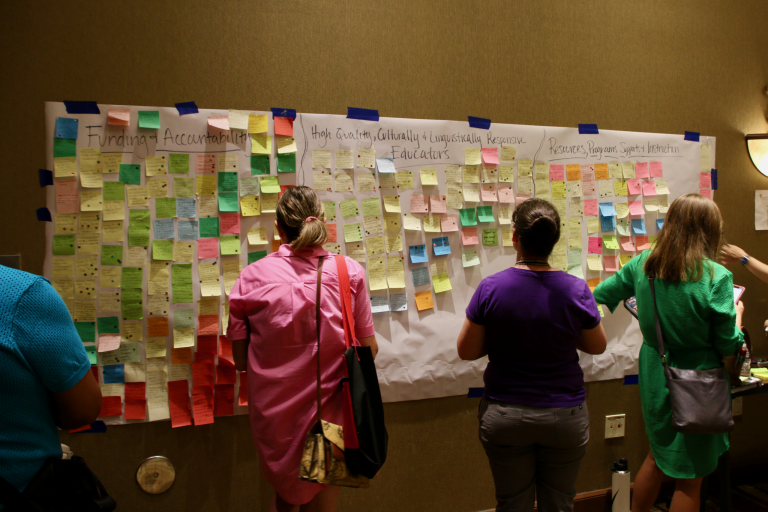
The agency, contracting with two nonprofits, gathered public input through a survey and a dozen meetings around the state before delivering a draft plan last fall, which Native education experts criticized as vague.
The final version “falls woefully short,” the Yazzie plaintiffs’ legal team wrote to the court last week. The Martinez plaintiffs signed on and filed similar objections.
One of the key points of contention is that PED organized the plan by four general areas for improvement. It should have instead structured it around the four student groups named in the case, with strategies specific to each of them, along with timelines, funding, and who’s responsible for those actions, the plaintiffs argue.
“[I]mproving inputs on a universal basis, without deliberate attention to disparate impact, does not close equity gaps and may exacerbate them by further advantaging students already better served by the system,” they wrote. To examine the plan, the plaintiffs say they collaborated with experts in special education, teacher preparation, and other fields.
The plan also fails, the plaintiffs wrote, to provide “achievable compliance measures” related to the New Mexico Indian Education Act — meant to ensure Native students receive a tribally-controlled education that relates to their cultures and protects language — and other relevant state statutes.
While it notes the importance of heritage languages broadly, they added, it is “silent as to the linguistic needs of Native students,” including language revitalization. The plan doesn’t describe, for instance, how PED will work with tribes and Native language experts to develop instructional material, the plaintiffs wrote.
For many advocates, the case is about much more than improving academic outcomes.

“We have an incredible responsibility that we cannot fail, because failure is going to result in language loss that will lead, as the elders teach us, to cultural loss, and when that happens, that will be the end of us,” said Regis Pecos, a former governor of Cochiti Pueblo and co-founder of the Leadership Institute at Santa Fe Indian School.
A Navajo Nation Council committee and the Mescalero Apache Tribe passed resolutions rejecting the plan. The Jicarilla Apache Nation and All Pueblo Council of Governors, meanwhile, addressed letters to Wilson, the judge, with the council writing that the plan doesn’t incorporate the Tribal Remedy Framework, a roadmap for educating Native children that was endorsed by leadership of every tribe in the state.
Students have “inherited a broken system,” with classroom materials that don’t reflect them and their communities and teachers who sometimes don’t know how to best support them, said Loretta Trujillo, an educator and the executive director of Transform Education NM.
“So accountability is not blaming students. It’s not blaming families,” Trujillo said. “It’s asking the question, ‘How is the systemic design fundamentally not working for our communities in New Mexico?’ And this lawsuit really is designed to raise the question and require that the state has to move beyond what is comfortable.”
The plaintiffs, in a joint motion last week, asked the court to order PED to go back to the drawing board, arguing its plan is neither comprehensive nor actionable, which is what the judge mandated. The court should also, the motion argues, compel the agency to contract with various experts and meaningfully consult tribes in the development of a new plan with a cost analysis and a five-to-seven-year timeline.
“The Defendants have had ample time and opportunity to remedy the Court’s previous orders and ongoing constitutional violations of students’ rights through extensive, adequate and meaningful planning and community engagement,” the motion reads. “The Defendants have missed their chance to do so.”
The state has a little less than 30 days to respond.
Update, Feb. 26: New Mexico In Depth updated this story to include comment from the Public Education Department.
This story was originally published by New Mexico In Depth.