by Jesse Jones, City Desk ABQ
The Albuquerque City Council uses ranked choice voting (RCV) for its own internal seats. Now, Councilors Tammy Fiebelkorn, Nichole Rogers and Stephanie Telles have introduced Ordinance O-26-13 to extend that same system to citywide elections by November 2027.
Under RCV, voters rank candidates by preference. If no one secures a majority, the lowest vote-getter is eliminated, and their supporters’ second choices are redistributed until a winner emerges. This “instant runoff” eliminates the need for a separate second election.
“If it’s good enough for us, it’s certainly good enough for the citizens,” Fiebelkorn said.

By the numbers
Since 2013, Albuquerque has held six runoff elections costing taxpayers over $4.79 million. The City Clerk confirmed the $1.6 million estimate for the 2025 runoff, though the County Clerk’s final bill reached $1.8 million.
“Do you know how many housing vouchers we can do for $1.6 million?” Fiebelkorn said. “This is not the time to be wasting money on something like a runoff election.”
Beyond costs, voter engagement is declining. The 2023 runoff saw a record low of 4,625 ballots, and the 2025 mayoral runoff had 5,191 fewer voters than the general election.

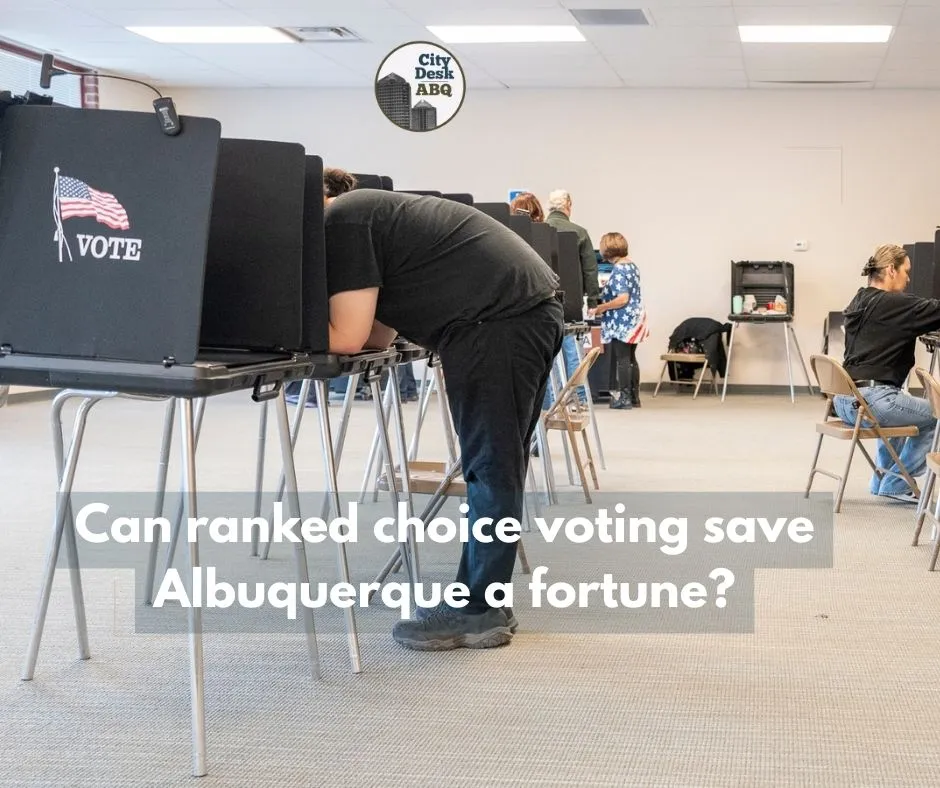
Photo by Roberto E. Rosales / New Mexico News
Proof of concept
The cities of Santa Fe and Las Cruces already use the system. In 2025, Santa Fe decided an eight-candidate mayoral race in seven rounds of counting on election night, according to the Santa Fe Reporter. There, Michael Garcia led in the first vote and ultimately prevailed after lower-earning candidates were eliminated.
A November SurveyUSA poll found 77% of voters in Santa Fe and Las Cruces said their ranked-choice ballot was simple to complete.
In Albuquerque, a survey conducted after the December runoff found most voters would prefer a single election. It also found 59% would support switching to ranked choice voting, according to FairVote’s 2025 Year in Review.
Molly Swank, executive director of Common Cause New Mexico, said the system addresses campaign fatigue. “The people are ready — now, we just need the City Council to catch up and honor the will of their constituents.”
Albuquerque Runoff Elections Since 2013
Source: City Clerk’s Office; Bernalillo County Clerk’s Office
| Year | Ballots Cast | Cost |
| 2013 | 87,323 | $667,045 |
| 2017 | 96,906 | $840,890 |
| 2019 | 13,479 | $368,675 |
| 2021 | 16,091 | $610,424 |
| 2023 | 4,625 | $500,000 |
| 2025 | 129,036 | $1.8 million* |
| TOTAL | ~$4.79 million |
*Final actual cost billed to the City by Bernalillo County Clerk’s Office, per Nathan Jaramillo.
Lived and learned
The three sponsors of the ordinance have all navigated runoffs as candidates. For Telles, the experience was deeply personal. Her 2025 District 1 race went to a runoff after she earned 36% of the vote in the general election.
“Ranked choice voting would have allowed me more time to spend the holiday season with my mom, who was in hospice care at the time,” Telles said. She called the switch a “no-brainer” for anyone looking to save the city millions of dollars.

The opposition
This is the city’s fourth attempt to pass RCV since 2019, and familiar hurdles remain.
Councilor Dan Lewis, who co-sponsored a competing plan for plurality voting, told KRQE that RCV is “unfair, complicated and untrusted.” He argued it violates the “one person, one vote” principle. Councilor Brook Bassan also expressed concerns that the system might not give candidates an equal opportunity to win.
Mayor Tim Keller, who vetoed a competing plurality voting measure in 2024, also supports the ordinance. “I have always supported ranked-choice voting.”
Fiebelkorn rejected the idea that the process is too complex. “Your first choice vote is counted, and then — just like if you go back to vote a second time in a runoff — you get your second choice logged at the same time,” she said.
Implementation and outreach
One major technical hurdle has already been cleared: The Bernalillo County Clerk’s Office confirmed that current voting machines are already configured for RCV and require no hardware modifications. The County Clerk would continue to handle the tabulation of election results under the new system.
Cristobal Rocha, program administrator for the City Clerk’s office, said the November 2027 implementation date is a realistic timeline for building a robust education program. The office has not yet received a formal directive but is already in contact with Santa Fe and Las Cruces to study their RCV implementation efforts.
The ordinance directs the City Clerk to conduct a voter education campaign before the system takes effect—a provision sponsors say is critical. The SurveyUSA poll underscored the need for outreach, finding one in four Las Cruces voters did not know their city used RCV before voting in November 2025.