“Dead Rivers” with Reed Black is a podcast about the management of water in the Western United States. Listeners will travel with Reed to meet the rivers and waterways that have carved out the West. You will learn about the tributaries that support communities off the main channels and how these communities are working to save these essential resources. So grab your water bottle and let’s get wet! Below is a transcript of Episode One: The Gallinas.
Hi! Welcome to the first episode of Dead Rivers, a podcast where we talk about the management of water in the West. My name is Reed, like the reeds in a river, and I’m so excited to take you on a journey to meet the waterways that make life possible here in the Western US. For our first episode, we’re heading to where the Southern Plains reach the Sangre de Cristo Mountains to meet the Gallinas River.
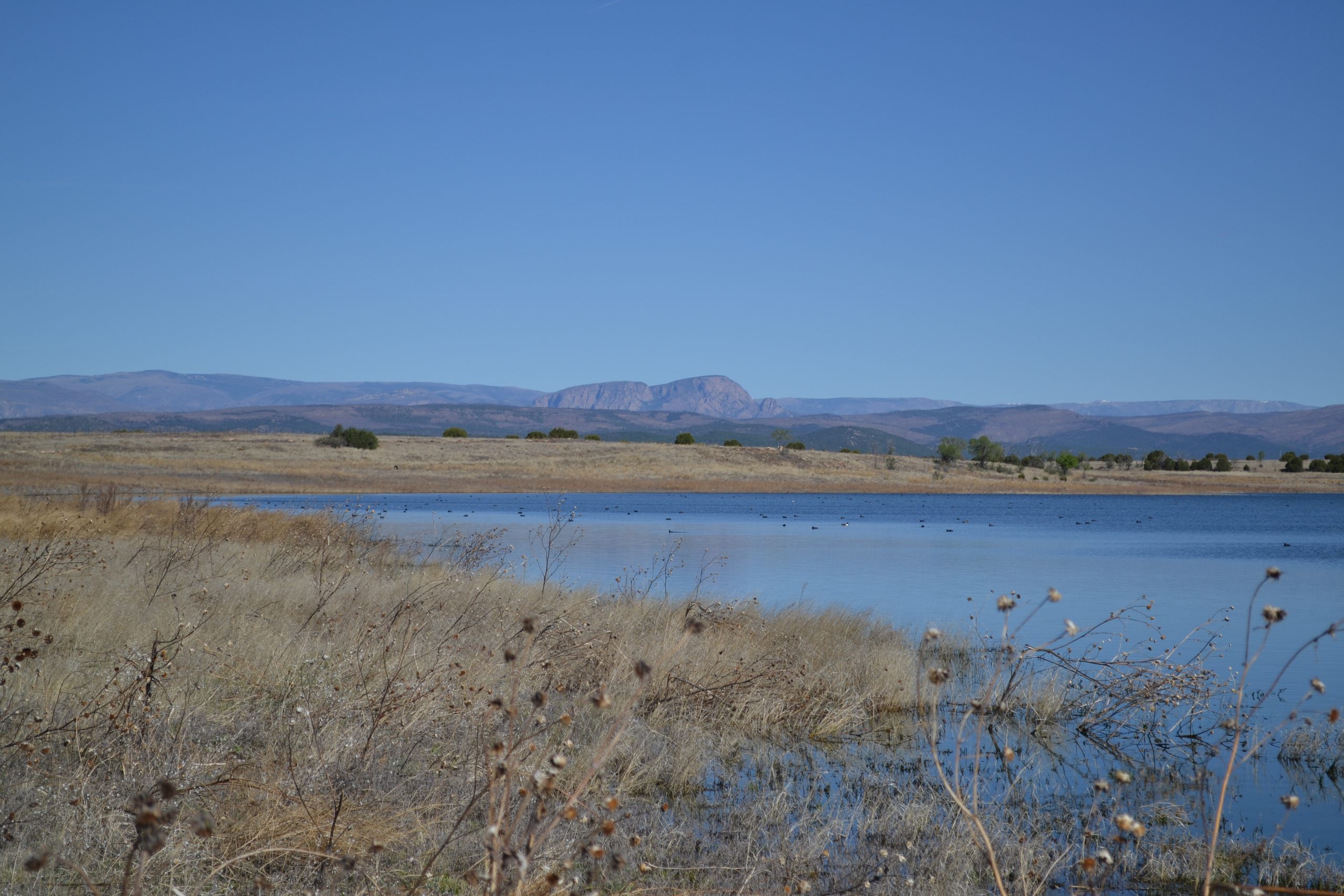
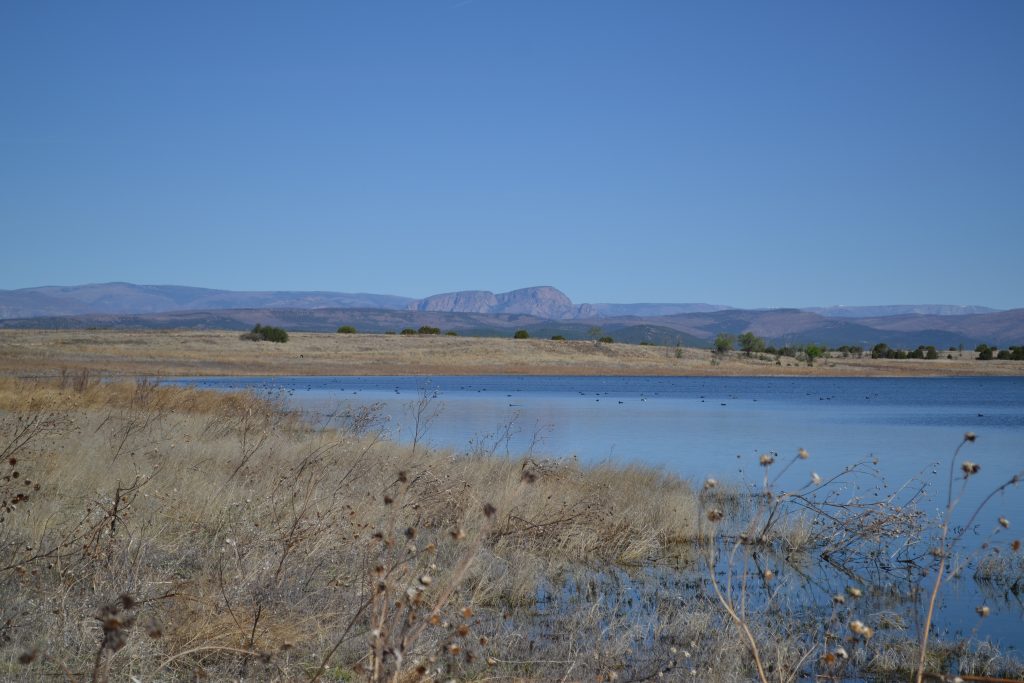
The Gallinas trickles through one of the many box canyons at the Las Vegas Wildlife Refuge. While I was at the refuge, I was able to talk with Anna Blade, refuge manager at Rio Mora National Wildlife Refuge and acting project leader for the Northern New Mexico Refuge Complex. Blade told me about how the refuge works to mimic natural wildlife habitats.
“They’ve been highly, highly, highly worked by humans, but they’re playas. They’re seasonal ponds,” She said. “And so those seasonal ponds, you think about the monsoon season in July, you think about how the snow run off the monsoons, and you think about shore birds migrating in the Spring and the Fall, you have grebes that nest, as you think about, like, what those seasons are for wildlife and how water plays in with that. So now we mimic those because it’s highly altered, but we mimic those seasons to create wildlife habitat.”
In order to mimic these habitats, the refuge needs a supply of water. That’s where Storrie Lake comes into play. Storrie Lake is a reservoir on the Gallinas River, supplying water to not just the refuge but also acting as a recreational area for the region. Its water is managed by the Storrie Project Water Users Association, which votes on how much water will be released from the lake. To access the water, users must call on their “water master,” Blade said.
“Water Master, we call on our water,” she said.
“It gets released from Storrie. It has to make its way. It’s like 17 miles, and there’s a lot of evaporation, but then it comes to us, and we have the ability to store it,” she said.“We’re actually one of the only users that has the ability to store water. So, we have Bentley, and we have Melton, and those are two bigger reservoirs. And so from there, we actually have a pipeline throughout the whole refuge. And so we can manipulate the water, and we can irrigate wetlands. We like the playas and do it for shore birds, but we also can irrigate grasslands.”
After speaking with Blade about how the refuge uses water from the Gallinas, I wanted to know more about the headwaters of the Gallinas above Storrie Lake. While I was traveling up the Gallinas, I met up with Estevan Gonzales, a project manager for Hermit’s Peak Watershed Alliance. He told me about the mission of the alliance.
“Our mission is to kind of protect the cultural and ecological heritage of watersheds in this Hermit’s Peak area region,” he said. “We really wanted to unite a somewhat disconnected community. There’s East Las Vegas and West Las Vegas districts, and they live kind of on opposite sides of the river. So, one of the founding principles of Hermit’s Peak Watershed Alliance was to unite the whole city with the fact that we share the river as a common resource, and we should care about the river.”
He told me about how the alliance mainly works in the Gallinas, Sapello and lower Mora watersheds, building restorative structures to preserve them.
“Some of the structures we build in watersheds are mostly low tech, process-based solutions or nature-based solutions,” he said. “And our approach with that is to be not so invasive with our building materials, with the structure. So, we use rocks and logs that are found on-site —so, already existing within the landscape —instead of using steel or rebar to build these structures.”
Their goal is to build structures that can help both reintegrate natural resources into the environment and assist in the performance of natural processes. Gonzales also explained the types of structures they build in watersheds.
“So, a couple of the structures that we build are rock structures. We have one-rock dams. Those are kind of a grade-control structure,” he said. “The name is a little bit misleading in multiple ways. I mean, one, rock dam. It’s built with multiple rocks. But the rocks are meant to be the same height, so it looks like it’s just one row of rocks altogether. And the ‘dam’ [part of the name] is misleading, because water is actually meant to flow through a one-rock dam. It’s just meant to slow the erosive energy of the water, so that way more sediment is allowed to be captured, and water is spread out across the channel and the flood plain.”
“Trash racks are meant to filter sediment and debris from coming from areas up higher in the watershed, up higher upstream,” Gonzales continued. “Log mats are meant to kind of stabilize the channel beds, so that way erosion doesn’t get deeper and in size further. And log step downs are kind of meant to create a tiered kind of structure. So that way the energy from water falling off of a steep drop off is dissipated by each step.”
In addition to restoring natural river processes, the filtering that the alliance does helps keep sediment and ash out of the water that goes to the Las Vegas Water Treatment Facility, which provides a majority of the drinking water for the City of Las Vegas. The Hermit’s Peak Watershed Alliance’s work takes them right to the sources of the Gallinas, helping to protect the headwaters.
As the Gallinas meanders out of the mountains, it supplies safe drinking water to the residents of Las Vegas, it then fills Storrie Lake, before creating wetland habitats at the refuge for migratory birds. In a very short stretch, the Gallinas does remarkable work for its local community, supporting life in this corner of New Mexico. Downstream, the Gallinas then joins the Pecos River, which is where we’re heading for our next episode.
We’ll be joined by Janice Varela, the traditional communities organizer for New Mexico Wild. Here’s a clip of the next episode from Varela:
“So the water in the Pecos River is important to us for recreation, fishing, hunting, but also for agriculture,” she said. “And we do have some small farms in Pecos, but most of the farming occurs downstream from the upper Pecos, where we are in Villanueva. So, it’s very critical that they have water that’s clean. They’ve had issues in the past with mining contamination, where they weren’t able or they were concerned about using that water for irrigating their food crops. Yeah, so it is a concern. It’s a beautiful valley and very important for agriculture and our ranching traditions in the community.”
Until next time, stay tuned and stay curious.