The following is a transcript of episode one of the podcast, “Mexican Gray Wolves: An Unlikely Endangered Species.”
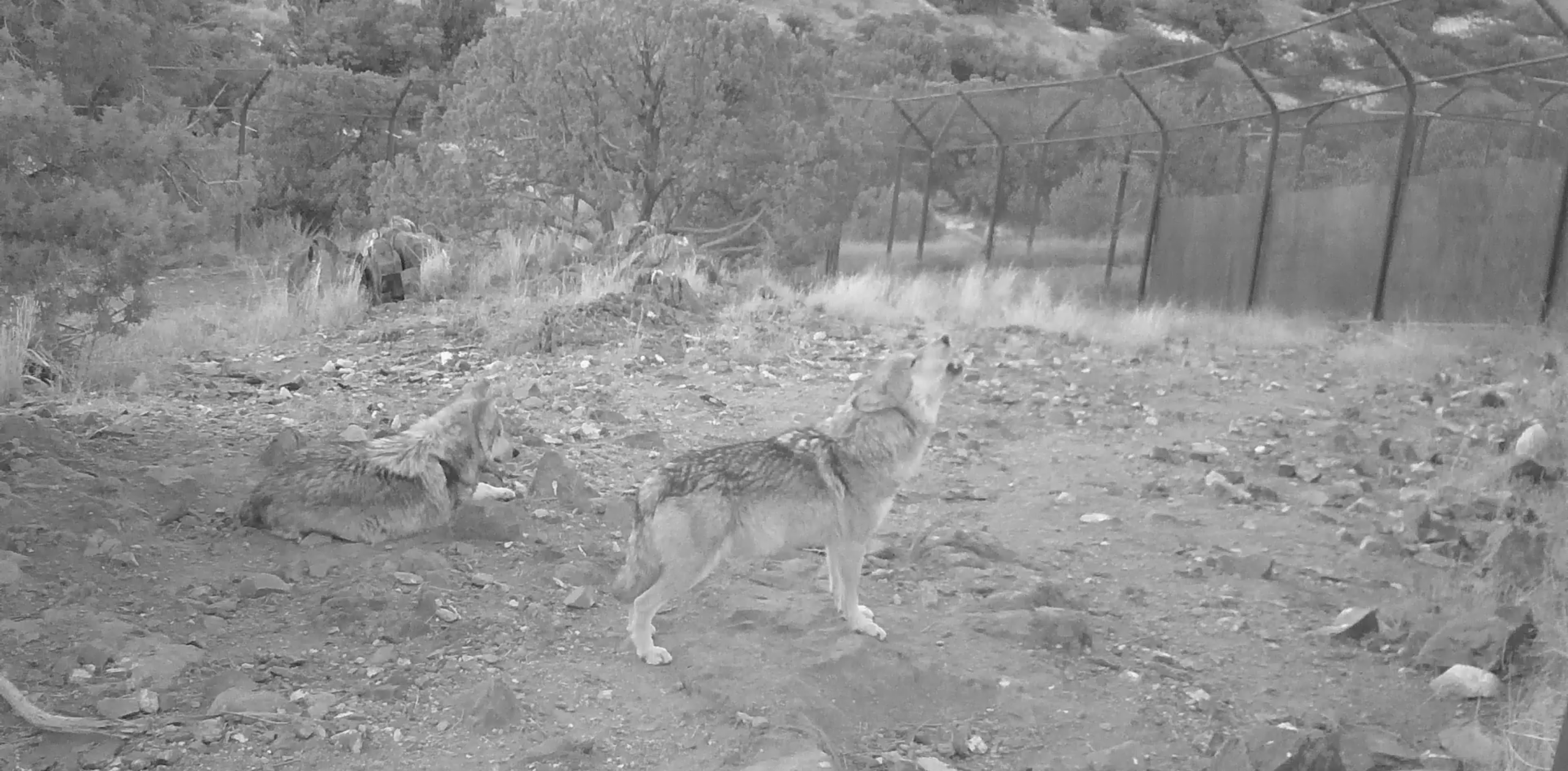
Welcome to Mexican Gray Wolves: An Unlikely Endangered Species, I’m your host, Max Ulz. On this podcast, we’re going to explore both the endangerment and hope that these wolves have experienced over the last 40 years — though the saga goes much further back.
For our first episode, we’re going to explore the topic of the wolves’ genetic diversity — which maybe surprisingly has become a highly contentious issue. You’ll hear from three individuals tied to this species: A couple wildlife experts and a journalist who’s followed the wolves’ story for years.
So why is genetic diversity a concern? Well, there are two populations that are restricted to their respective recovery zones and aren’t allowed to roam beyond their borders. Journalist Bryce Dix has covered the issue extensively for public radio station KUNM.
“And what conservationists are saying to me is that, ‘Look, there are northern gray wolf populations in Colorado, Utah — even as far north as Montana And we would like for Mexican gray wolves up there to intermingle with southern populations the Lobo populations here in Arizona and New Mexico.’ Because, they say, there’s a huge genetic diversity crisis.”
The federal government established these areas in 1998.
“A part of the reintroduction of the Mexican gray wolf, there’s something called the ‘10- J rule.’ And this rule is very specific in the Endangered Species Act, where it allows the federal government, the U.S. Fish and Wildlife Service, to create an experimental population area that allows the Mexican gray wolf to roam in a certain place. So, here in the Southwest, the Mexican gray wolf is only allowed to roam in New Mexico and Arizona, only as far north as Interstate 40.”
The highway runs pretty much right through the middle of the state. Mary Katherine Ray is the wildlife chair for the Rio Grande Chapter of the environmental advocacy organization the Sierra Club. She is not in support of the I-40 boundary.
“I think I saw this statistic lately that 11 or 12 wolves have made that journey north,” she said.
“So, obviously there’s something up there for them, when wolves who independently, on their own, still striking out and going there.”
Advocates like Ray see southern wolves wandering beyond their zone’s boundary as a step in the right direction because it gives them a chance to diversify their gene pool.
“We’re losing genes,” she said.
Ray said that’s because the separated populations are only allowed to inbreed.
“We’re not supposed to marry our cousins,” she said. “Theres a reason for that — because all the bad mutations become expressed instead of having at least one copy of a gene that’s good, you end up with two copies that are bad.”
She argues that allowing the populations to interbreed would stem the species losing genes.
“With time, if you let the ones in the south meet the ones in the north, natural selection would again play its role in creating a replica of the subspecies that used to exist.”
But not everyone agrees with her. Stewart Lily, chief of the wildlife management division in New Mexico’s Department of Game and Fish is one of them.
“Yeah, I would disagree with that, right? So, the decision is to really keep separation of the subspecies,” he said.
He said the separation is important, especially as the endangered species recovers.
“And so we’re trying to keep Mexican gray wolves during this recovery phase south, and hopefully you get them well connected to the south, into Mexico, right into the historic — 90% of Mexican wolves’ historic range was in Mexico,” he said. “So, if you get back filling within there, any integration at the very north zone is going to have very little impact to the southern zone in Durango, Chihuahua, whereas now any integration might have bigger consequences.”
Lily argues allowing the wolves to roam beyond their zone boundaries would put the endangered species at risk.
“So, just that zone of separation right now is definitely kind of necessary during this recovery phase.”
Lily’s concerned with the increased risk of ranchers who are protective of their livestock killing the wandering wolves. Reporter Bryce Dix broke down why.
“But also there’s this other aspect of the agricultural industry and the agricultural industry since the 1800s has really been targeting Mexican gray wolves because they do something called depredate on livestock,” he said. “So, they kill people’s livestock, and that’s why they were almost wiped out from existence in the first place.”
This is where the argument gets political — more political than it already was. We’ll delve more into that in the episodes to come, but all you need to know for now is that ranchers live all over the wolf recovery area. Dix has heard from many of them.
“When I ask them what’s the big issue and they’re like, ‘Well I, as like a small farmer, when I lose one steer from a Mexican gray wolf depredation, that’s pretty impactful for me. It’s just like you losing a couple thousand dollars, just randomly.’ It’s like, yeah, I can totally relate to that problem.”
Advocates for interbreeding, like Mary Katherine Ray, see living among the wolves as an opportunity for the ranchers.
“My hope is that maybe the presence of wolves will make you pay attention to your cows more,” she said. “And, if you do that, you might actually discover that, ‘Oh there’s a disease going around among them, maybe we should get a medication or a vaccination.”
But Ray said the tension between advocates like her and cattle ranchers isn’t always so clear cut.
“There is this culture that, you know, you’re on team rancher and that means you’re not on team wolf,” she said.
Tune in next week where we’ll discuss Mexican gray wolves’ impact on riparian areas, a phenomenon called “trophic cascade,” and the wolf’s role as a keystone species.
Once again, I’m your host Max Ulz and this is Mexican Gray Wolves: An Unlikely Endangered Species.