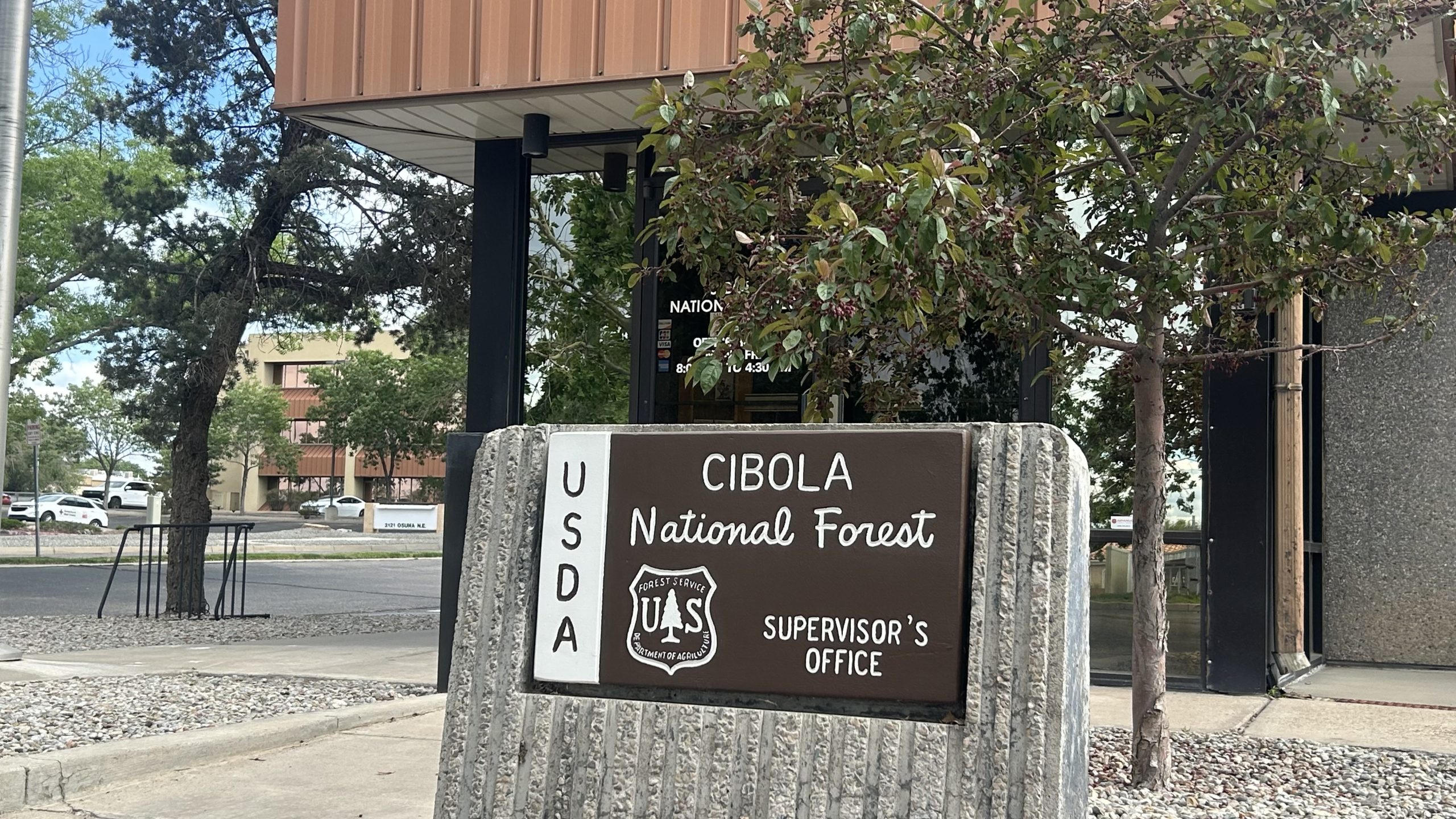
President Trump’s administration has started a sweeping restructuring of the U.S. Forest Service, which manages close to 193 million acres of federal land across the country. More than 10 million of those acres are in New Mexico.
According to the administration, the move will place leadership closer to the communities they serve. Critics, including members of New Mexico’s congressional delegation, say the changes will result in layoffs and less research on Forest Service land.
The U.S. Department of Agriculture, which oversees the Forest Service, announced its headquarters will be moving to Salt Lake City, Utah, as part of the major restructuring move.
Sally Perez is the staff attorney of New Mexico Wild, a membership organization with a focus on land stewardship and conservation.
“I’m a one-person legal team there,” she said, “Our organization does public lands conservation work, so we focus on wilderness, water and wildlife.” The Forest Service is already understaffed. The Department of Government Efficiency (DOGE) cut an estimated 3,400 jobs last year, leading to volunteers stocking and cleaning vault toilets at some parks, according to the Aspen Times.
“We’re seeing right now a whole combination of different things that are affecting the way that our forests are managed that are going to have, I think, really big implications in New Mexico,” Perez said.
Fifty-seven research stations are slated to close out of the nearly 80 stations nationwide.
“As those people who have sort of the institutional knowledge and expertise and experience with the agency are leaving, we’re really ending up with folks that, one, don’t have those specialties, and two, they just don’t have the experience working there,” Perez said.
She said she’s seeing that, when anyone tries to interface with the Forest Service for any reason, they have difficulty making a point of contact.
“People in New Mexico love our forests,” Perez said. “We rely on them for our recreation. We rely on them for our clean water, our clean drinking water.”
According to the USDA, while all regional offices will be closed or consolidated during the transition, the office in Albuquerque will remain open. The agency’s website says that one office will take on multiple functions, including as the New Mexico State Office, an Operations Service Center and a Business Support Service Center.
“I definitely think that a lot of those restructuring changes, as well as the funding changes and the staffing cuts — that they have to have an impact on our ability to be ready to respond to the impacts of climate change,” Perez said.
After several requests by phone and email, spokesperson for the U.S. Forest Service Ivan Knudsen said no one was available for an interview. Instead, he provided a statement attributed to a USDA spokesperson, which said the transition will “occur in phases” and that “the number of relocations beyond those already identified are unknown at this time.”
The statement went on to say the reorganization changes “do not eliminate scientists, end research programs, or reduce the agency’s broader geographic presence.”
Research will continue across the country, according to the statement, and the closures, in what the USDA characterized as “many cities,” were “only to individual buildings where small groups of scientists sit today.” The spokesperson said those scientists will continue working for the department.
There have been mixed responses from government officials on the restructuring. Republican Governor of Utah, Spencer Cox, and Democratic Governor of Colorado, Jared Polis, praised the changes in statements, with Cox calling it a “big win for Utah and the West.”
Democratic U.S. Senator from New Mexico Martin Heinrich led a letter to USDA Deputy Secretary Stephen Vaden voicing concerns about the jeopardization of research and functionality of the Forest Service. More than 30 other senators signed on to the letter, including New Mexico’s other Democratic Sen. Ben Ray Luján.
Over in the House, Rep. Gabe Vasquez (D-NM2) also condemned the restructuring on the floor, calling it a backdoor move to strip resources from the agency.
“We need more, not less, U.S. Forest Service resources and staff out West in places like New Mexico,” he said. “Stripping resources from an agency that’s already stretched thin and struggling to mitigate the impact of wildfires is the opposite of common sense. It is stupidity.”
Vasquez, a co-founder of the Bipartisan Public Lands Caucus, also said moving the headquarters to Utah and closing research centers is a slap in the face to Teddy Roosevelt, who established the Forest Service more than a century ago.