Youth sports scheduler Amanda Gilmer prefers Little League umpires who she thinks do it for the love of the game and for the growth of the children playing the game.
But one umpire who checked all of Gilmer’s boxes had just returned to the field after recovering from surgery when he saw firsthand how brutal sports parents can be.
“Parents were telling him how awful he was, and how he was playing favorites and that he was just a horrible umpire,” Gilmer said.
“And then he kept asking me ‘Am I in trouble? Can I still umpire?’ and it broke my heart,” Gilmer said.
He passed away two years later.
Gilmer said this situation is just one of many facing those who officiate youth and prep sports. Coaches and players face similar issues dealing with unruly parents, spurring the New Mexico Athletics Association (NMAA) to take action in an effort to reverse this trend.
‘A Different Kind Of Classlessness’
There’s not a lot of glory in being a Little League umpire, Gilmer said. “You’re out in the heat for hours and you’re calling this game the best you absolutely can and being berated regularly.”
The abuse can be hardest on younger umpires. “Teenagers are not equipped to have adults just constantly hounding them and calling them names and cussing at them,” Gilmer said.
Parent behavior in the crowd at sporting events can get so bad, it interrupts the game. Sean Trotter, baseball and golf coach at Farmington High School, once had to call a timeout during a game to address a particular bad actor.
“I have indeed had to tell a parent that their behavior was unacceptable and that, if they couldn’t stop yelling at the umpires, that we would have them removed,” Trotter said.
For Gilmer, punitive action like ejecting parents and banning them from future games has been the most effective way to curb this overzealous behavior.
“It seems like the only thing that’s working is when they see that there are consequences for their behavior,” Gilmer said.
In 2019, the National Federation of State High School Associations (NFHS) “distributed an op-ed suggesting that inappropriate behavior by parents and other adult fans at high school sporting events was causing many officials to quit before they even reached two years on the job.” Gilmer sensed the “growing problem” as New Mexico came out of the COVID-19 pandemic lockdown.
“It went from parents being ‘Oh, that’s a horrible call,’ to actually cursing at umpires, threatening to fight umpires,” Gilmer said.
Trotter has also seen parents take to the Internet to berate coaches and players, something he calls ”a different kind of classlessness”.
“The ability to sit at a keyboard and feel invincible, saying whatever comes to mind, has been a wild escalation of bad behavior,” Trotter said.
Mike McGaha, head baseball coach at Carlsbad High School, said he’s seen more focus on youth sports stardom in recent years.
“The parents and players are out of touch with what it means to be inside of a ‘team’ concept. They don’t care about anybody other than the name on the back of their jersey,” McGaha said.
Umpires are not the only ones who have to worry about job security when it comes to unruly parents.
“You just have to have a very loud few.“
Clifton Davidson, the head boys basketball coach at Bernalillo High School, said a small group of disgruntled parents campaigned to get him fired from his previous job at Bosque School after a tightly contested game toward the end of the regular season.
“We pushed [Hope Christian] down to the wire and they beat us on a buzzer beater shot. And the next morning at 9 a.m., I got fired,” Davidson said. After Davidson was fired, the rest of the basketball coaching staff and the school’s athletic director all resigned within a few weeks.
Davidson said he suspects one of the parents was unhappy with their son’s performance and role on the team. Head of Bosque School Dr. Jessie Barrie said the school is “not participating in interviews on this topic.”
The relationship between parent and coach can be contentious anywhere in the state. Coach McGaha, who previously coached in Farmington and Albuquerque, knows all too well.
McGaha recalled a situation in which a parent complained loudly that his son wasn’t getting enough playing time and the parent’s action had the opposite effect. The boy’s playing suffered and the coach believed part of the problem was that his teammates’ feelings about him had changed.
“The player admitted that he felt torn because he felt like he was in the middle of having to choose between his coach and his dad,” McGaha said.
In Farmington, Trotter had a similar story when one of his players apologized on their parents’ behalf for being drunk in the stands.
“Security had to come escort the parent from the stadium,” Trotter said, and remembered the child was “clearly upset at the behavior of their parent”.
In these instances and many others across the state, student-athletes are put in awkward and uncomfortable situations by their parents.
“Dad, I need space.”
Zac Stevenson, director of officials services and assistant director of sports at NMAA, sees improvement in the situation – even if it’s in small increments.
“We can’t walk around the stands and stop to talk to every person that behaves a certain way, but we can certainly change the pulse in the room and kind of lead by example,” Stevenson said.
That example includes a joint summer conference with coaches, athletic directors, sports officials and a group of student leaders to collaborate on ideas to help curb poor sportsmanship by everyone involved in prep sports.
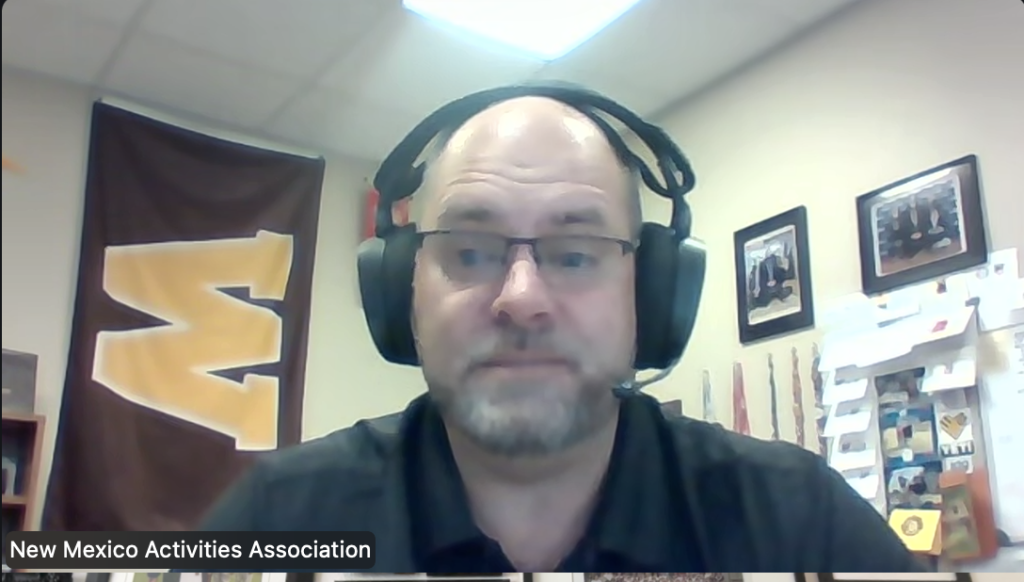
Stevenson says one idea shared during these conferences has been “hands-up” and “hands-down” communication.
“When a coach [or umpire] throws his or her hands up on the sideline, so does everybody else,” Stevenson said, resulting in an “adversarial demeanor… that starts to reflect in the kids”.
Stevenson says encouraging “hands-down communication” during these conferences has already paid off. A wrestling coach once told Stevenson communication suggestion “made a huge difference”.
Still, Stevenson knows there are still parents who haven’t received the message. Stevenson recalled a star student athlete, who was asked by a motivational speaker if she would change anything about her races if she had that kind of control.
Stevenson said the student-athlete, normally reserved and quiet, responded, “The hardest thing for me in cross country is the pressure my dad puts on me. I just wish I could tell him ‘Dad, I need space.”