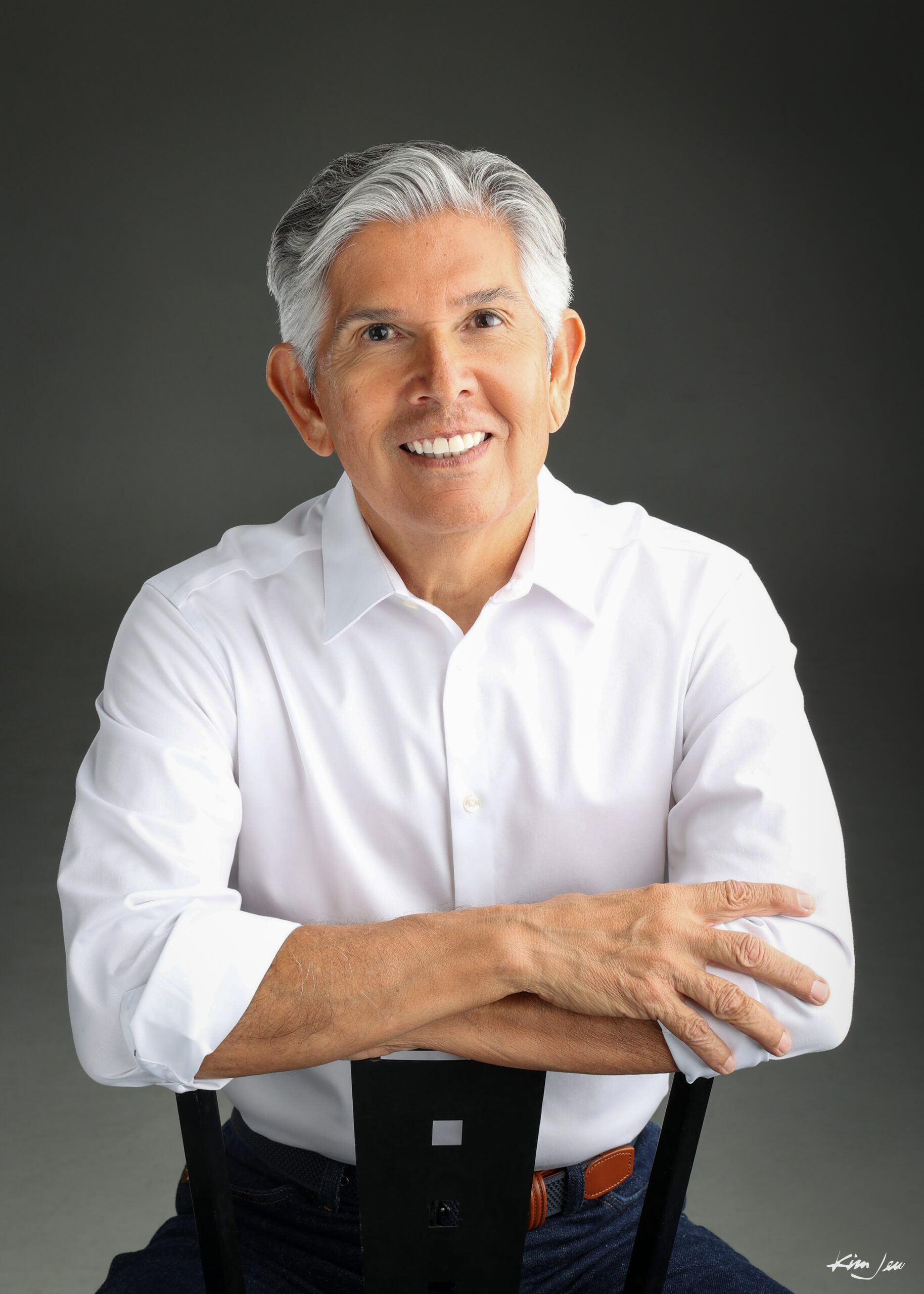
By Azure Mitchell, New Mexico In Depth
Republican gubernatorial candidate, Duke Rodriguez, said his campaign is rooted in what he calls “the true New Mexico experience.” From growing up in a rural community and graduating at New Mexico State University to becoming the Chief Operating Officer of Lovelace, one of the largest healthcare companies in the state, to founding the cannabis company Ultra Health, Rodriguez says he has a debt to pay to New Mexico.
In an interview on April 6, Rodriguez pointed to New Mexico’s stagnant population and claims this is a sign of a poor economy and limited opportunity. He emphasised the state’s large budget and argued that higher spending has not led to better outcomes for residents. Aside from the budget, Rodriguez also linked the state’s lack of growth to job scarcity, relocation, and the rising costs of living.
Rodriquez would reprioritize spending, eliminate the state personal income tax and the gross receipts tax on retail sales, develop oil and gas refinery infrastructure, and make preventative healthcare more accessible.
He said that the New Mexico Rail Runner Express and Spaceport America are vanity projects. Funds should instead be spent on projects that benefit more of the population, he said, like multicomplex sports venues. He emphasized the need for a water desalination program across New Mexico regions, saying that New Mexico is far behind not only Texas, but other countries in its efforts to tap brackish water.
As for border security, Rodriguez said he agrees with President Trump’s goal to secure the border, but does not agree with his mass deportation agenda. He emphasized that the White House should be held to its word to focus on “the worst first” rather than target undocumented immigrants without crime records. He proposed the creation of a modern Braceros Program, which was an agreement that existed from 1942 to 1964 between the United States and Mexico that provided legal labor migration between the countries.
Rodiguez also criticised the recent Immigrant Safety Act that Gov. Michelle Lujan Grisham signed into law in February that bars public resources being used for immigrant detention, which effectively leads to counties no longer partnering with ICE on detention centers. He said the bill is a sign that New Mexico’s leaders assume cities and counties will not act responsibly regarding immigration.
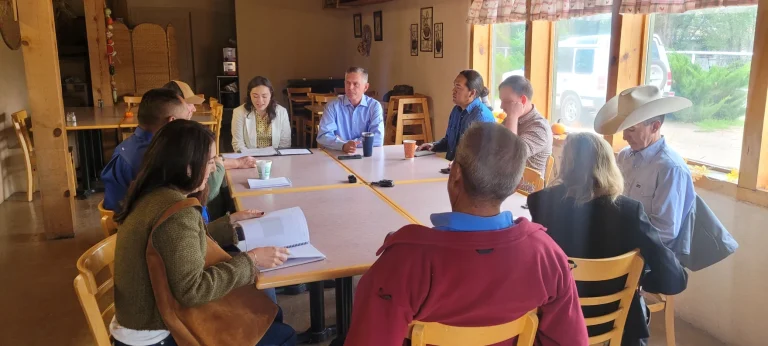
To follow is a transcript of the interview, lightly edited for clarity.
What’s motivated you to run for governor at this point in your career? What do you believe New Mexicans need most right now?
I’ve spent about 54 years in New Mexico and grown up living what I call the true New Mexico experience. I’m a product of rural education, Silver City, Alamogordo high schools. And a product of New Mexico State University. And certainly, like many in my generation, we migrated to Albuquerque and started building our careers In Albuquerque.
I had the good fortune of buying my first home right out of college. And, you know, I’ve lived through all levels of what I describe, again, as the New Mexico experience, whether it’s Medicaid or SNAP — then it was called a food stamp, food assistance program — student loans, basic education, opportunity grants. I actually even lived in the housing projects in Alamogordo. And through all those experiences, I’ve always looked at New Mexico as this land of great opportunity. And unfortunately, over the past few decades I’ve seen that opportunity literally evaporate.
We’ve seen increased crime. A failing education system. A much more difficult health care system to access. And across the board, we’ve just seen increased cost of living here, and the affordability issue has just been devastating. But if you look at all those things, and you look at the span of my life’s work, it is clear that I have been very blessed by New Mexico and have had exceptional success. I ran, at one time, one of the largest healthcare systems in the state. And I thought, nobody has a greater debt back to the state than myself. And that is the primary reason that I believe serving as governor is the least I can do to give back to the state that’s given the most in opportunities.
You have a background in healthcare, in separate fields. You propose guaranteed access to healthcare, but your campaign also says you want to avoid raising taxes and instead redirect existing resources. Can you walk through specifics of what this actually looks like, what programs or funding streams would you cut or restructure to pay for it?
Well, I don’t believe that there will be a lot of downsizing. I think there is more about prioritizing better. And you have to understand that 10 years ago, our population was approximately 2.1 million people in the state, and today it’s 2.1 million people in the state. When you look at that, at the same time, we’ve had a stagnant population and a stagnant economy. Our spending has increased from, the Susana Martinez period when we were operating with annual budgets between 5.2 and 5.4 billion, and now we are operating at twice that level.
So, we’re now operating at budgets in excess of 11 and almost 12 billion. Actually, we’ve even changed the method of how we track our budgets. And so much of our budgets, even being, shall I say, masked in other activities. And so when it was easy to measure our budget, we don’t realize that we’ve moved dollars into other line items. Used to be, this may be a bit more than you’re asking for, it used to be that you could generally look at the appropriations act and know exactly what our annual spending was. That’s no longer the truth, and we’ve increasingly moved dollars into separate line items.
So, if you look at what our spending is and certainly how much it’s grown, there is certainly room to be more efficient and redirect some of those dollars. Some of the areas for example, are what we call the high risk pool. I think our high risk pool is about $165 million committed to provide health care coverage to less than 3,000 enrollees. And it’s generally an unmanaged program. Heck, look at our Medicaid program. When I talk about an annual budget of $12 billion, that’s general fund. We probably spend close to 15 billion a year in Medicaid and Medicaid related expenses. That’s not in that number.
So, we are [on] a much larger budget to begin to rein in some costs. We spent on upgrading a Medicaid IT system. This is not getting care to patients. This is not increasing rural access. This is simply administrative costs. We spent in the last year $330 million on that alone. So we have plenty of other areas we could reprioritize our spending and be able to eliminate state income tax, like nine other states. I’m talking state income, personal income tax. Eliminate Gross Receipt Tax on retail sales. And you need to understand that’s a very specific wording, because that is not elimination of all Gross Receipts Tax, but elimination on those taxes that benefit and impact most of families, whether they’re buying clothes, pencils, diapers, those are the direct costs. And I think we could reasonably afford that immediately, without cutting back in services. And I believe we can also cut back on property tax, not eliminate, but reduce property taxes.
All of those go along with your mission to have guaranteed access to health care?
Absolutely, because earlier health care is less expensive than deferred health care, and when we get guaranteed health care, it certainly has a heavy emphasis on primary care. We tend to, in New Mexico, just write checks for all health care. And because we have a very fragile and limited primary care model, most of our care ends up in the ER and in later stages of more expensive medical care. We have one of the highest rates of diabetes in the country, hypertension, cardiac cases, and most of those are also lifestyle related. And the fact is that most, a lot of good quality health care in New Mexico is delayed care.
Imagine dermatology. I mean, it’s well known that UNMH (University of New Mexico Hospital) recently sent out a notice to future and existing patients. The wait time for a dermatology exam, let’s say you have an unusual growth on your hand, on your face, and you want to see a dermatologist to see if it’s possibly cancerous. The waiting time now is eighteen months. Eighteen months later is far more expensive than a dermatology exam in the next 30 days, if it progresses, it becomes more of a oncology visit versus a first-time routine visit. I think we’ve lost sight of the very simple facts about health care economics. Any care, whether it’s preventative, prenatal, early childhood, any care that is delayed, every time will cost you nine and ten times the cost for every month that it’s delayed. So a $30 visit turns into a $300 program, which turns into a $3,000 procedure.
So you’re guaranteed access to health care plans to cut these costs and wait time?
Increase access and make primary care more affordable and more available.
Many New Mexicans live below the poverty line. If you’re elected, what would you do to improve the economy and lives of these New Mexicans?
That’s a great question because most folks don’t fully understand the real importance of having a vibrant population, which means that it’s growing, and having a thriving economy. If we don’t create job opportunities, if we don’t create opportunities for advancement, many of our young people will leave our state. Many of our established population will find bigger opportunities and better opportunities in more successful markets like Austin or Dallas or even, believe it or not, Denver and Oklahoma City. There are better opportunities in Phoenix and other markets are not too far from New Mexico.
Part of success and part of reducing crime, part of improving education, part of reducing mental health problems, part of dealing with addiction, has to do with the reality that we have a stagnant population and, worse yet, a dying economy. We have a sovereign fund you may have heard of, a rainy day fund, and people will tout it, saying ‘It’s a $72 billion sovereign fund,’ and it ranks as apparently the second largest sovereign fund in the U.S. By the year 2030, it’s expected to be $110 billion. That is the sign of a very wealthy state on paper. That is not a confirmation of a state that invests in itself.
I’ve said this over and over. New Mexico is not a poor state. We are absolutely a poorly run state. We are exceptional at increasing spending. We are terrible at investing in activities that enhance the life of New Mexicans. I don’t believe in vanity projects. I look at the rail runner and the spaceport as vanity projects. Limited use, limited benefit to our population. Heck, I would rather us build a multi-complex for sports, for a community. A new stadium — we have soccer fields and baseball fields and jogging — a lot of outdoor and healthy activities. Something that connects the population statewide.
I would rather build a desalination program to put desalination in the areas that we desperately need it. Lea County, Eddy County, Doña Ana County, Bernalillo County, San Juan County. Desalination. New Mexico is way behind in bringing forth desalination. States like Texas have nearly a dozen of those in place, and probably the second largest in the U.S. is located right in El Paso. We lack in forward-thinking investments. Unfortunately, we commit wholeheartedly to very rapid spending and with sometimes very limited positive results.
You just mentioned desalination. New Mexico faces long term water shortages and a lot of water issues. Do you have any specific policies that you would implement to secure water for agriculture, cities and industry?
I am a huge proponent of desalination. I travel internationally. I’ve seen desalination facilities in place. I’ve seen them in the Middle East, I’ve seen them in Europe. And I realize that with our significant amount of brackish water we have in New Mexico, we are a perfect candidate for converting brackish water into usable water. I find it hard to believe that we can continue to evaluate and encourage large data centers, whether it’s Facebook or Project Jupiter, and that we don’t always keep a very open mind and eye to the reality that we need to replace, supplement, and produce more water than we currently do. It’s not that we should turn our back on these projects, but every one of these projects should have a counter balance to replace, produce, or show a method of why we’re going to have even a greater amount of water before we approve the project. These projects should never be dilutive. These projects should have conditions built into them and functions that will increase water availability, not limited.
If you were to become governor, do you happen to have a solid plan for water?
I’ve got a multi-phase project, which not only includes our typical state resources of our state engineer. And I think they’ve actually made some good policy choices, but I don’t think those policy choices do enough. We need to build infrastructure. Infrastructure, not in hoping for better weather. Not infrastructure based upon hoping for a wetter, you know, heavier snow pack from the previous years. I think that’s just rolling the dice. We need to take the initiative with whatever plan we put out there. We need to take the initiative of emphasizing recapture and production of additional water.
Oil and gas is a huge reason for New Mexico’s large budget. Do you have a plan to maintain that revenue while also addressing environmental concerns?
I don’t think that having a optimistic outlook, like drill baby drill, has to be contrarian. Taking responsibility for making sure we recognize the risk on our environment. I think being blessed with an abundance of natural resources is a good thing. I don’t think there is any shame in being the second largest producer of oil and gas in the U.S. Those natural resources have put us not only in the position of having one of the largest sovereign funds in the country. Our sovereign fund would put us in the rank of being 29th in the world, if we were a nation, just New Mexico alone. But by having such a largess of treasury reserves, we are in a great position to deal with the changes in climate. To deal with water scarcity. To deal with, which is going to happen in New Mexico, for example, wildfires. They are a reality. We’re not going to simply pray them away. But we are a state with tremendous resources to begin to build up precautions and protections from these risks of a changing climate and environment.
I’m not, just to clarify, I’m not a climate denier. I feel the risks are real. But unlike most states in the country, we have the resources to be proactive and address these challenges. Most states don’t have that opportunity. They can only deal with the crisis as it presents itself. We’re in a very envious position of putting significant sums of capital forward to protect and enhance our population. I witnessed what happened in Hawaii with the high winds and the fire that destroyed one of the most historic towns of Lahaina. One of my great fears for New Mexico is not just what’s happening in southeastern New Mexico. I think we can deal with that very effectively. I have equal or greater fears about wildfires, human created or by natural climate issues. It would devastate our state.
With water concerns and our deep need for the oil and gas industry in New Mexico, do you have any views on produced water use?
I think the fact that the ability to make produced water, which is desalination, should be a built-in mandate on committing to further exploration resources. Keep in mind, I’m not pushing for restrictive restrictions on oil and gas. I think we could actually become even more efficient. Technology is getting better, not worse. I’ve advocated for us to leverage our strong foothold in southeastern New Mexico by appointing a new secretary of energy that’s not based in Santa Fe, but is located in southeastern New Mexico, either Chavez, Eddie or Lea County.
I’m not opposed to making our investments in infrastructure down there more effective, that we can do more refinery along with our significant investment in drilling. The less transportation of natural resources across state lines, the better off we’re going to be. The only reason that Texas out produces us is they’ve been way ahead of us in putting infrastructure around those natural resources. We primarily just have been an extractive industry, not a refinement industry. I actually support very strongly in encouraging further expansion in southeastern New Mexico, but in a way that we get this, this new bounty of treasury and invest back in our community, which means our people and our environment.
Do you believe New Mexico should respond to border security challenges, and what do you think should be left to the federal government? Do you agree with Trump’s approaches to immigrant deportation?
I believe the White House has been properly interested in protecting and closing our borders. I agree. I agree to the point of making sure criminals, hardened criminals, are not entering this country. I agree to the point of illicit drugs like fentanyl not entering this country. I agree our borders should be protected. Believe it or not, and it happens, and we have seen it before, where national security is not compromised by having an open border. I believe all those protections, when looked at with a common sense mentality, make absolute and complete sense.
Where I begin to get concerned, is something I would call mass human deportation. I believe in holding the White House to their word of deporting the worst first. That should be an obligation that every administration should have. And at the same time, I also recognize the importance of a workforce in New Mexico, similar to the old Braceros Program, if you would call [it] that, where we actually had work permits given to workers to come into our dairy farms, into our alfalfa fields, come into New Mexico to pick our beloved green chili. And in an effective Braceros Program with appropriate safeguards, we can get the workforce we actually need.
Keep in mind, having access to a productive and economical workforce makes those products more affordable to our population. I would hate to see a bag of roasted green chile go to $500 because we’ve gone too far in one direction and not provided enough workers to actually produce and harvest our products. We are not Massachusetts, we are not Vermont or most eastern seaboard states. We are a state that is located physically close to the international border. And as governor, I would advocate to make sure whatever policies that are carried around our borders, that they are also sensitive to our culture, to our people and to our economy.
Recently, Governor Lujan Grisham signed a bill, the Immigrant Safety Act. If you were to be elected, how would you deal with this bill?
I’ve always said that devils are in the details. I think what they’ve done within those bills may ultimately prove to be irresponsible. I think, to automatically assume that our local leaders in our cities and counties will not act responsibly in developing detention centers that are humane and compassionate is a real slap in the face.
I can’t speak to how they run detention centers in Texas or Wisconsin or Michigan. But if we are going to have detention centers, which are really a reality in today’s population, then New Mexico should be a leader in demonstrating how it can be done with real care, concern and compassion for those who are detained.
Individuals who require some detention for whatever short or long period will now be directed to other states when their family members or their community may just exist, five, ten, fifteen miles down the road. I think it is a real disservice that we now use the word ‘We’re to ship them to whatever state.’ That’s just irresponsible. And that’s also not letting our facilities evolve with the standard across the country. If something starts off with what I would call a rough start, that means you just that doesn’t mean you just bail on it. You basically push back, and you develop some better way of doing it.
It’s a poor corollary, as they say, a better mousetrap, because it isn’t a trap, but you build a better solution. Just because others have not always acted responsible doesn’t mean that your own house will act irresponsible. That was a determination we did not have to make. Is it good public policy to build safeguards? Absolutely. But safeguards are a complete opposite to completely eliminating the ability to carry out a program. Safeguards and elimination are not the same thing.
This story was originally published by New Mexico In Depth.