By Azure Mitchell, New Mexico In Depth
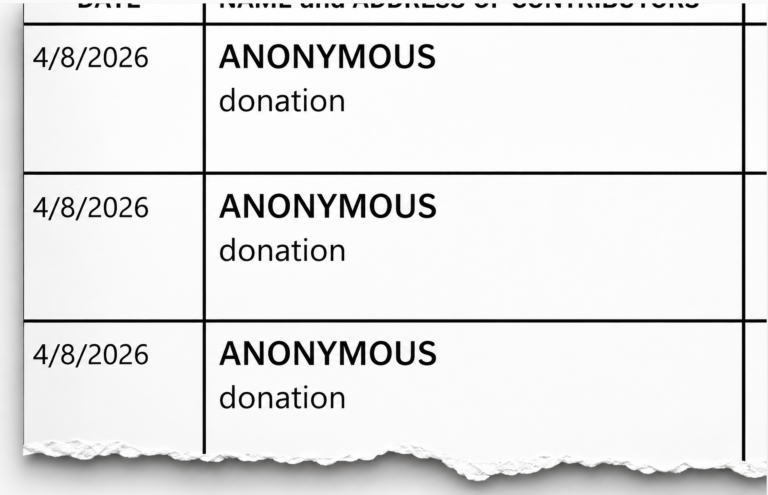
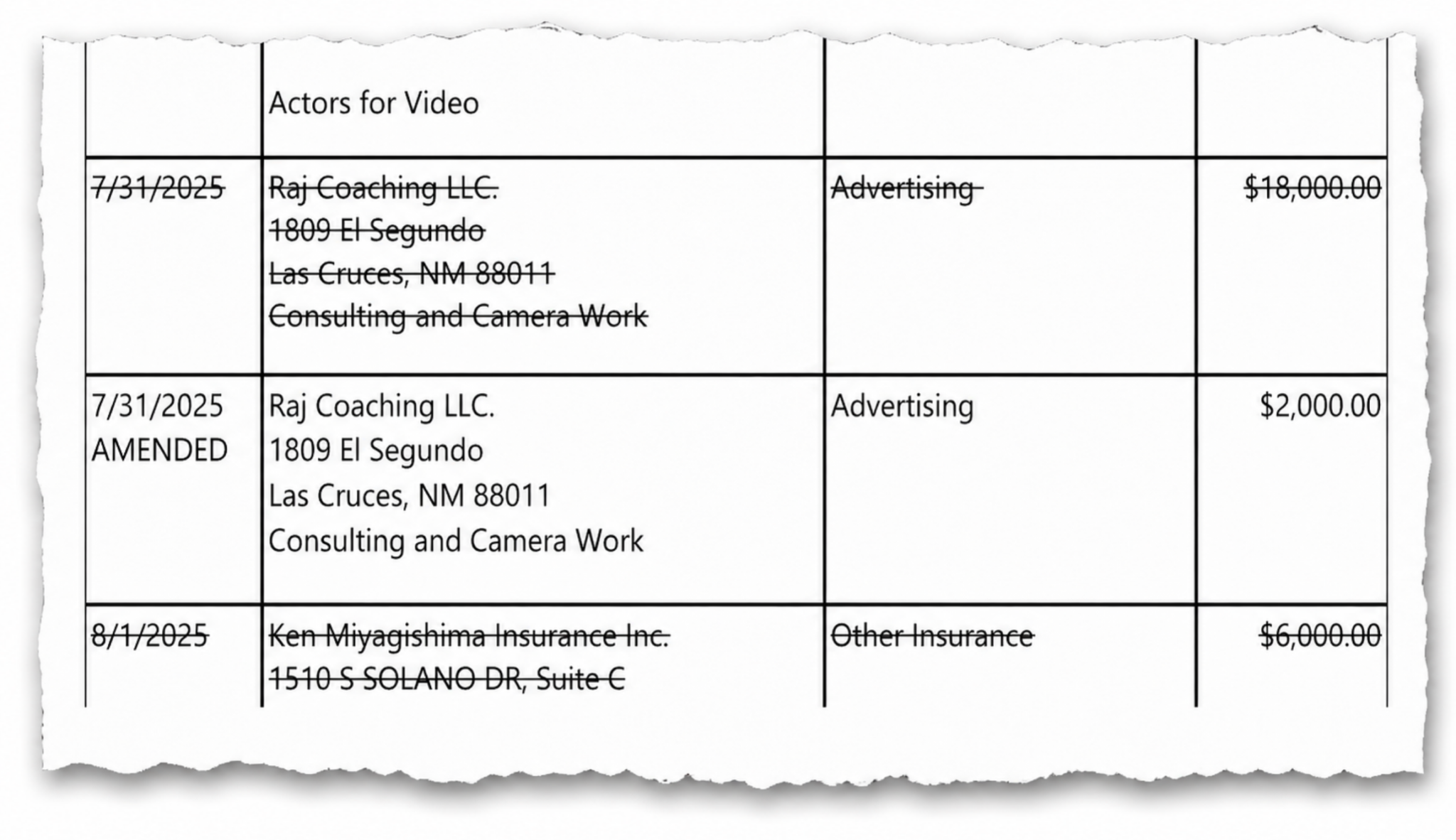
After New Mexico In Depth reported in February that gubernatorial candidate Ken Miyagishima had exceeded limits by more than $125,000 on the amount of donated goods and services his campaign could receive, Miyagishima found a creative resolution: crossing some of them out.
Those changes appear in an amended report he filed in February.
But Miyagishima’s next campaign finance report, filed April 5, doesn’t show payments back to the companies whose contributions he crossed out. That raises a question: whether the campaign received services it later erased from its reports without paying for them.
Miyagishima told New Mexico In Depth that the Secretary of State (SOS) has not required him to pay the vendors for the excess contributions. The agency’s director of communications, Lindsey Bachman, said the office seeks voluntary compliance from candidates who violate campaign finance rules, but did not answer questions from New Mexico In Depth about whether candidates must pay back the excess or pay a fine for each contribution over the limit.
Crossing out campaign contributions
Miyagishima says he accepted contributions over the limit because of bad guidance from Secretary of State staff. In May 2025, Miyagishima asked Elections Deputy Director Charles Romero in an email for clarification on whether in-kind contributions were unlimited. In a reply email, Romero appeared to affirm Miyagishima’s interpretation that the statute allowed unlimited in-kind contributions. The candidate then accepted the donated goods and services and reported them in October.
Miyagishima amended the October report in February, after New Mexico In Depth discovered the excess, slashing in-kind donations so that the overall in-kind total dropped from $254,544 to $74,434 — a reduction of $180,110.
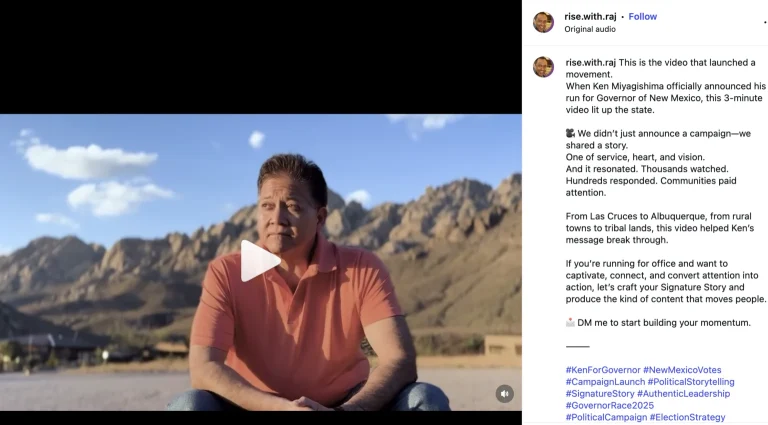
- Raj Coaching LLC — Original entries totaling $101,350 were reduced to approximately $12,000. All of these services were for producing political videos, including payment for actors.
- Ken Miyagishima Insurance Inc. — Large recurring entries ($5,000–$6,000 each) for office help, meals, gas, and use of the company car were cut to $1,000–$1,500 each; the smaller itemized purchases (signs, stickers, pins, etc.) were unchanged. The total was reduced from $49,244 to $29,744, still exceeding contribution limits.
- TTG Inc. — Each $5,500 monthly entry was reduced to $1,000; the final October entry for $5,500 was not amended. In total, the value of in-kind services from TTG Inc. was reduced from $33,000 to $10,500.
- Jolly Rogers Software LLC — The value of social media services was reduced from $37,500 to $9,500.
- Louie Ortega — The donation of a song for the campaign was reduced from $22,700 to $3,940.
The revised figures land every vendor, except for Miyagishima’s insurance company, within campaign contribution limits.
Making campaign contributions disappear
Miyagishima’s next campaign finance report, filed April 5, shows he paid Raj Coaching LLC $8,000 between October 2025 and March 2026. But those payments don’t correspond to the services whose valuations were retroactively slashed in the February amended report. Other vendors whose in-kind contributions were crossed out — TTG Inc., Jolly Rogers Software LLC, Louie Ortega, and Ken Miyagishima Insurance Inc. — received no payments in the new report.
Meanwhile, other Miyagishima-affiliated entities have stepped in as the campaign’s primary in-kind contributor since October. Miyagishima & Co. Insurance LLC – Roswell is separate from Ken Miyagishima Insurance Inc., but Secretary of State records show Miyagishima as its registered agent. The Roswell company provided $18,687 in in-kind services during the primary reporting period — paying for TV ads, radio, printing, and TTG consulting — approaching but not yet crossing the $24,800 limit. Another company registered to Miyagishima, Miyagi-Sol, provided in-kind support of $2,000.
Miyagishima defended the fixes he made in an April 21 email to New Mexico In Depth, stating that Secretary of State staff did not tell him to pay the companies for the in-kind services he erased. He also shared a Feb. 27 email between himself and agency staff where he admitted to the violations and offered to pay a fine.
“I also read that I could be fined $1000 for exceeding the allowable amount, among other things,” Miyagishima wrote. “I would like to voluntarily pay the $1000 for exceeding the In-kind contribution amount.”
A $1,000 payment appears as an expenditure in Miyagishima’s recent report, described as a self-imposed fine paid to the Secretary of State on March 6. He told New Mexico In Depth that the agency has not cashed this check and has not communicated with him further.
In the same email to the agency staff, Miyagishima explained his amended reports, saying some vendors never finished their work and others he had stopped using. For Raj Coaching, he wrote, he had “originally used an arbitrary figure.” He was more direct about his insurance company:
“As for my insurance business, Ken Miyagishima Insurance Inc. I did clearly exceed the allowable amount. However, I did not intend to purposely exceed the allowable amount and upon learning about the maximum amount. I have stopped using in-kind contributions from my insurance business. I will now contribute to my campaign using personal funds.”
“Statute compels us to work with the candidate to seek voluntary compliance,” Bachman, the SOS communications director, wrote in an April 22 email to New Mexico In Depth.
In February, Bachman said the office was reviewing Miyagishima’s October report and wouldn’t have further information until that review was complete.
New Mexico’s campaign finance statute states that candidates may incur up to $1,000 for each violation of the rules and may be required to forfeit unlawful contributions. But it does not appear to mandate either penalty.
Seeking further explanation, New Mexico In Depth asked more questions on April 22. Bachman has not answered whether the review is complete or whether the office intends to fine Miyagishima for each violation on his October report. She also did not respond when asked whether the office gave Miyagishima wrong information to begin with or whether bad advice from the Secretary of State absolves a candidate of the responsibility to read the statute correctly.
This story was originally published by New Mexico In Depth.